A step-by-step development guide for ottoman rib, ottoman single jersey and yarn-dyed ottoman: ridge structure and cam charts, yarn and gauge, finishing that keeps the ridges round, controlling GSM and shrinkage, and testing, built on our development records.
At a glance
24ottoman entries in our register
-3.9%median finished vs required GSM
+12.6%median GSM rise after the wash test
2 of 3GSM lab results that failed
Ottoman rib is the knitted fabric with bold horizontal ridges running across the width, like a row of soft cords laid side by side. You see it on women’s tops, cardigans, dresses, sweatshirts and fashion trims, where a structured, heavy hand is wanted without a woven fabric. For the development engineer one simple knitting idea, extra courses on one needle bed while the other bed waits, explains almost everything about it: its look, its weight, its habit of gaining GSM when washed, and why careless finishing presses the ridges flat. This guide follows the full route from yarn to a tested fabric. It is built on our fabric register, which holds only 24 ottoman entries, and on just 3 ottoman test reports that reached our desk. That is thin data, and we say so wherever it matters. Where a value comes from general practice rather than our records, it is marked as typical.
If you are new to development, read the single jersey, rib and interlock guides first. Ottoman rib is knitted on the same double-jersey machine as rib and interlock, and the held-loop idea also appears in the waffle (thermal) guide.
What ottoman rib is
Structure: a tie course and a group of face courses
Ottoman rib is a double-jersey fabric. The machine has two sets of needles: the cylinder, whose loops form the technical face, and the dial, whose loops form the back. In plain rib both beds knit at every feeder. In ottoman rib the knitting is split into a repeat of two kinds of course:
- The tie course. Dial and cylinder needles both knit, like a normal rib course. This course joins the two layers together.
- The face courses. For the next few feeders only the cylinder needles knit. The dial needles miss: they stay down and hold the loop they made in the tie course.
Because the dial needles hold their loops, the back layer does not get longer during the face courses. The face layer, meanwhile, gains three, four or more courses. When the next tie course is knitted, all those face courses have to fit into the space of one back course. They cannot, so they buckle outward and form a rounded ridge. The next repeat makes the next ridge, and so on down the length of the fabric.
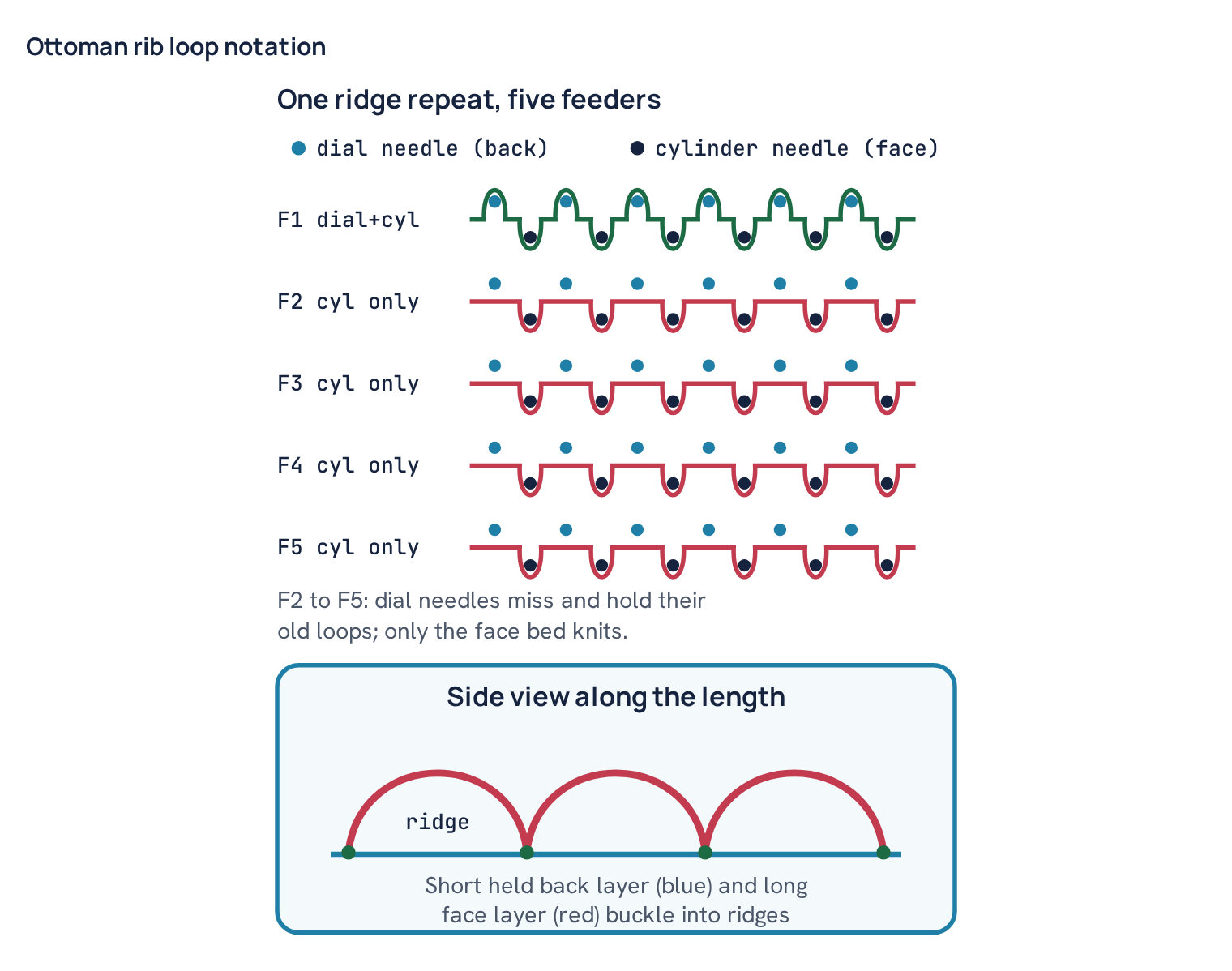
The face and back of ottoman rib do not have the same number of courses. That unequal count is the whole fabric: change it and you change the ridge.
Ottoman single jersey and yarn-dyed ottoman
Our register uses four type names for this family: ottoman rib, Lycra (elastane) ottoman rib, ottoman single jersey and yarn-dyed ottoman rib. The rib versions follow the principle above. A single-cylinder machine has no second bed to hold the back short, so the ridge is typically made by contrast between groups of courses, for example a band in a bulkier yarn or filament between courses where many needles miss or tuck. The arrangement differs from design to design, so record it from the machine rather than guessing it from the fabric.
Yarn-dyed ottoman is knitted from dyed yarns, often with the ridge in one colour and the tie course or ground in another, so the stripe follows the ridge exactly. It is usually washed and finished rather than piece dyed, and its fastness depends on the yarn dyeing; see the slub and yarn-dyed single jersey guide.
Properties you must design around
- It is heavy for its gauge. The face layer packs several courses into the length of one back course, and there is a back layer as well. More loops per square centimetre means more yarn per square metre.
- It shrinks and gains weight when it relaxes. In the machine, on the frame and in finishing the fabric is pulled in length, which opens the ridges. When it is washed and free, the short back layer pulls the ridges closed again. The fabric gets shorter, and GSM goes up.
- The ridges can be flattened. Heavy squeezing, length tension, high compactor pressure or calendering press the ridge down, and a flat ottoman can fail the buyer’s look standard even when GSM is right.
- Spirality is low. Like rib and interlock, the two beds balance each other. In our few lab reports, spirality after washing was 0.0% in all 5 results.
Development inputs
Read the buyer’s request carefully
Write down every requirement before any yarn is booked. For ottoman rib a typical request contains:
- Finished GSM with a tolerance, often ±5%.
- Finished width, open width in cm or inches.
- Composition, for example 100% cotton, a CVC or PC blend, a blend with elastane, or a mix of cotton and polyester filament.
- Ridge look: ridge height or ridges per cm, often given only as a reference swatch.
- Shade, or for yarn-dyed qualities the colour of each yarn and its position in the repeat.
- Wash care and test requirements: shrinkage, spirality, GSM, bursting, pilling, colour fastness, pH and fibre content.
The ridge look is the input most often missing. Two fabrics with the same GSM look completely different with a three-course and a six-course ridge, so get a swatch.
Choosing the yarn
Fibre. In our register CVC and PC blends are the largest family with 11 of the 24 entries, then 100% cotton with 8, CVC or PC with elastane 3, and cotton with elastane 2. Polyester in the blend helps the ridge keep its shape and lowers shrinkage, which suits a structured fabric. Cotton gives the softest hand and the cleanest piece-dyed shade but relaxes more.
Count and gauge together. Most of our ottoman is knitted on 18 gauge, which takes medium to coarse counts and gives a full, round ridge. Finer gauges are used for lighter, flatter ridges.
Combed, compact or open-end. Combed or compact ring yarn gives a cleaner ridge surface and better pilling. The face loops of the ridge sit on top and take most of the abrasion, so a hairy yarn shows quickly as fuzz on the ridge crests.
Twist. Because the beds balance each other, twist matters less for spirality than in single jersey. A normal knitting twist, typically an αe of about 3.2 to 3.8 for cotton (it varies by spinner), is a safe start.
Filament and slub. A polyester filament gives body and a crisp ridge; slub gives an irregular texture. Polyester needs disperse dye to match the cotton, and slub adds GSM and shade variation along the length.
Elastane. For stretch ottoman, a bare elastane filament is plated with the ground yarn, usually on the tie course or on all feeders of one bed. Elastane qualities need heat setting.
Common mistake: fixing count and stitch length from the GSM alone. At the same count a taller ridge packs more yarn into each metre and raises GSM, so GSM and ridge look cannot be chosen separately. Decide the ridge structure first.
Knitting
Machine, gauge and diameter
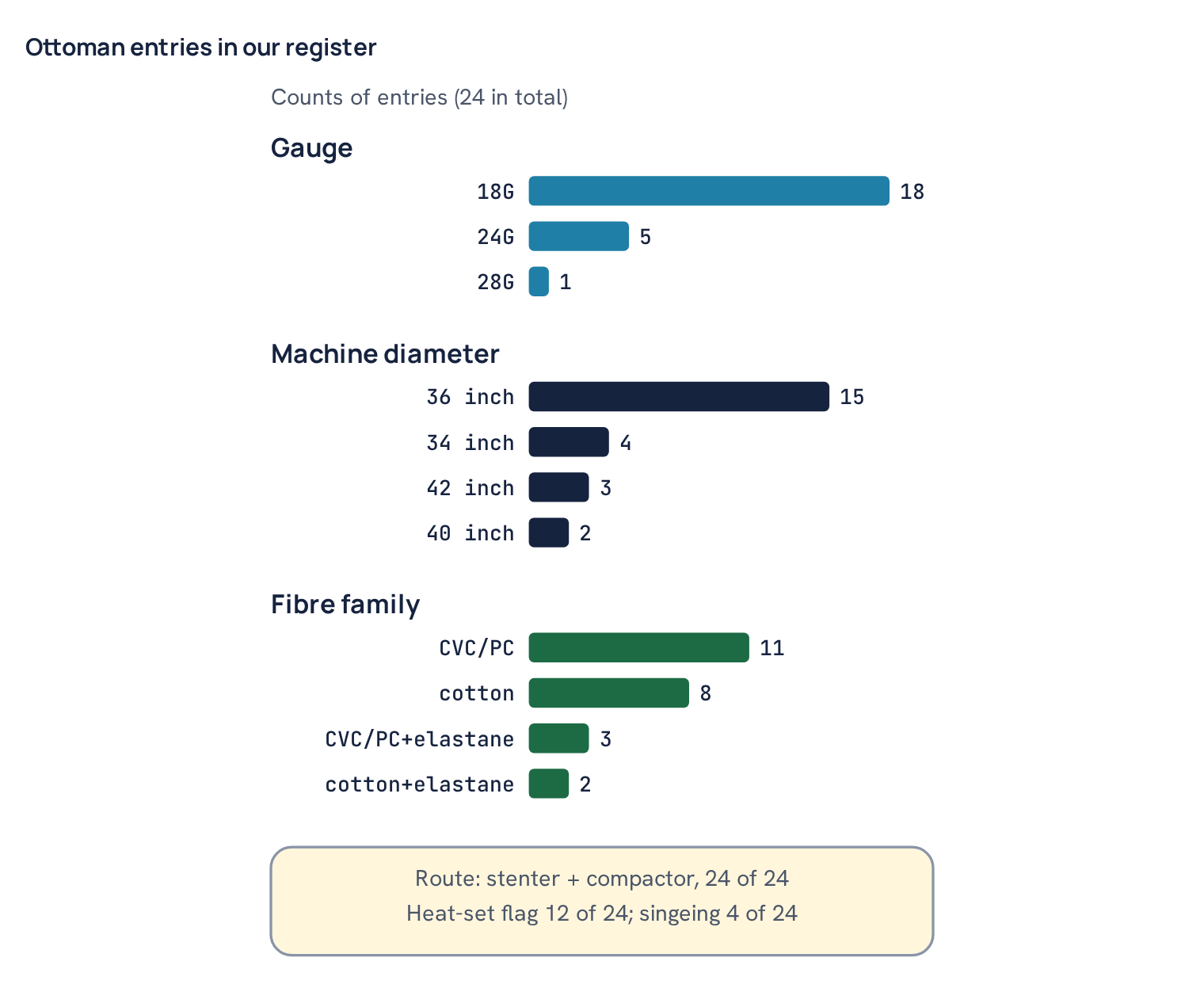
Ottoman rib needs a double-jersey circular machine with dial and cylinder cams that can be set to miss, in our register most often 18 gauge (18 of 24 entries), then 24 gauge (5) and one entry on 28 gauge. The most used diameter is 36 inch (15 entries), followed by 34 inch (4), 42 inch (3) and 40 inch (2).
Width comes from the number of needles. One bed has diameter × π × gauge needles, and the open width after finishing is roughly the face needles divided by the face wales per cm of the finished fabric.
Worked example. A 36 inch, 18 gauge machine has 36 × 3.1416 × 18 = about 2,036 cylinder needles. If the finished fabric shows 12.5 face wales per cm, the open width is about 2,036 ÷ 12.5 = 163 cm. If finishing pulls it narrower, to 13.5 wales per cm, the width falls to about 151 cm. Measure the wales per cm on every finished trial and you can predict the width of the next one.
Cam notation and ridge height
The knitting master sets the repeat on the cam tracks. A simple way to write it down is a cam chart: one column per feeder, one row for the dial and one for the cylinder, with K for knit and M for miss. The number of cylinder-only feeders in the repeat is the number of face courses in each ridge, and it is the main control of ridge height.
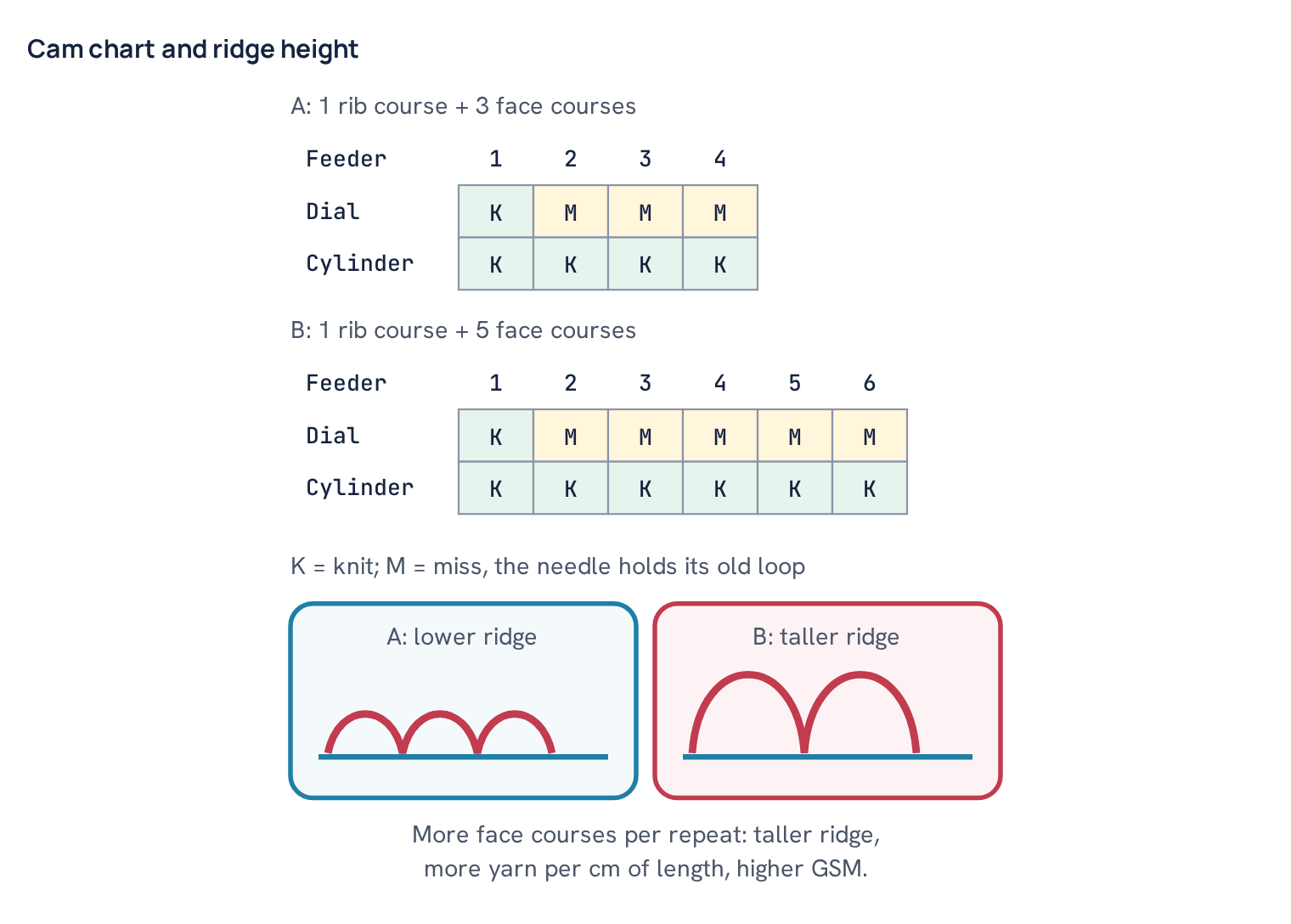
- Fewer face courses, typically two or three, give a low, fine ridge, a flatter surface and a lighter fabric.
- More face courses, typically four to six or more, give a tall, round ridge, more yarn per centimetre of length and a heavier fabric.
- Machine feeders. The number of feeders should be a whole multiple of the repeat, so every revolution knits complete ridges. A 6-feeder repeat on a machine whose feeder count does not divide by 6 leaves a broken ridge, which shows as a spiral line across the fabric.
Record the repeat (for example 1 + 4) and the ridges per cm on greige and finished fabric. These two numbers explain most failed ottoman trials.
Stitch length, count and GSM
GSM is the mass of yarn in one square metre. For one yarn and one stitch length it is GSM = (courses per cm × wales per cm × stitch length in mm × yarn tex) ÷ 100, with tex = 590.5 ÷ Ne. For ottoman rib, count each feeder of the repeat separately: add up, for every feeder, the wales per cm that knit there times the stitch length, multiply by the repeats per cm along the length, then by tex, and divide by 100. If the repeat uses different yarns, use each yarn’s own tex. The knit GSM from stitch length calculator and the general GSM calculator handle the single-yarn case; for ottoman, add the feeders up by hand.
What the formula shows clearly is the weight of the ridge. In a 1 + 4 repeat, each cylinder needle knits five loops for every one dial loop. All five sit in the length of one ridge. Add a sixth feeder to make it 1 + 5, and each ridge gains one more face loop per wale, while the length per ridge grows only a little. The fabric gets heavier much faster than it gets longer. That is why ottoman is heavy for its gauge.
Our recorded ottoman quality
Only one yarn group in our register has enough entries to show as a row. The register writes the yarn as “30/1 CTN + 28/1 SLUB + 150D POLY”, which means 30/1 cotton, 28/1 cotton slub yarn and 150 denier polyester filament. Stitch length is shown as the register records it, per yarn in yarn order.
| Yarn | Gauge | Entries | Stitch length per yarn as recorded, mm | Required GSM | Finished GSM | GSM after wash | Finished dia, cm | Shrink L / W, % | Spirality, % |
|---|---|---|---|---|---|---|---|---|---|
| 30/1 cotton + 28/1 slub + 150D polyester | 24G | 5 | 2.90 + 1.70 | 220 | 230 | 256 | 162 | -2 / -7 | 2 |
This is a small group, five entries of one construction, so read it as one example, not a rule. It finished at 230 GSM against 220 required, inside a ±5% tolerance, and rose to 256 GSM after the dye-house wash test. The wash test moved it more in width (-7%) than in length (-2%). The other 19 entries are spread over too many yarn combinations to summarise, so the rest of this guide uses group-level figures.
Elastane and multi-yarn feeding
- Elastane. Feed it from positive feeders with the same draft on every elastane feeder; a difference shows as a tighter or flatter ridge repeating around the fabric.
- Several yarns. Keep each yarn on the same feeders every time and record which yarn goes where. Swapping a filament and a spun yarn changes the ridge and the shade.
- Yarn tension. Keep input tension even, especially between the tie and face feeders. A tight tie course flattens the ridge; a loose one lets it balloon.
Machine settings to record
- Machine number, diameter, gauge, total feeders and speed.
- The cam chart: knit or miss for dial and cylinder at every feeder of the repeat.
- Yarn count, type, lot and supplier at each feeder; elastane denier and draft; input tension.
- Stitch length per yarn, measured on the greige.
- Take-down tension. Heavy take-down pulls the ridges open, so the greige looks longer and lighter than it will finish.
- Greige tubular dia, greige GSM, ridges per cm and roll weight.
Greige inspection
Let the greige rest for several hours before measuring, because ottoman relaxes visibly after take-down. Count ridges per cm in two or three places. Check for broken or missing ridges, which point to a feeder or cam fault, as well as holes, needle lines, drop stitches, oil stains and barre. Measure greige GSM and dia, and write them next to the cam chart. For barre caused by yarn lots or tension, see barre in knit fabric: causes and remedies.
Dyeing and finishing route
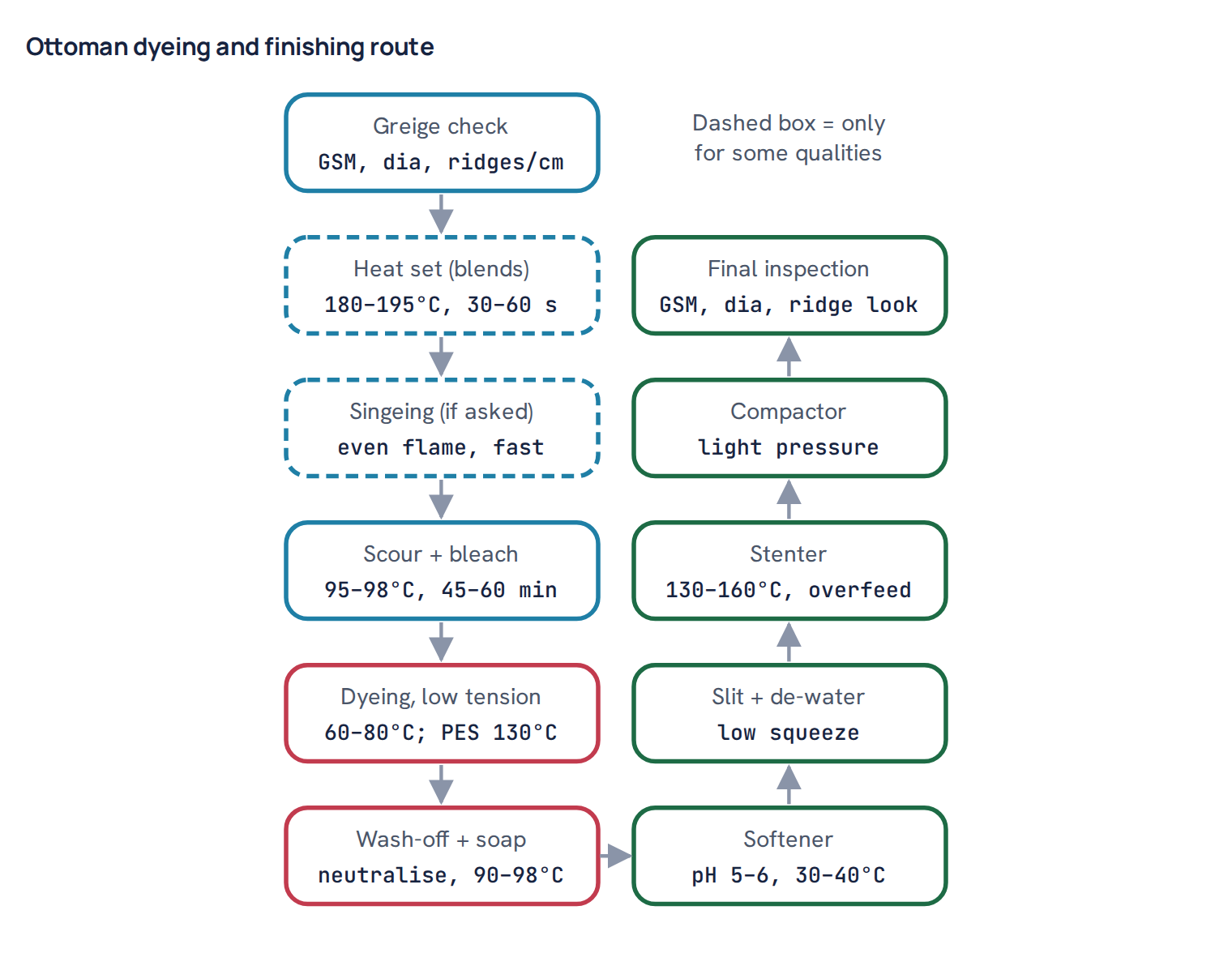
All 24 ottoman entries in our register are finished open width on stenter and compactor. Twelve carry a heat-set flag (50%), and four carry a singeing flag. The route below gives typical parameter ranges; exact values depend on the dyes, chemicals, machines and shade. A shorter overview is in the ottoman rib dyeing and finishing flowchart, and the wet processes are covered in 100% cotton knit dyeing process, CVC fabric dyeing process and cotton elastane (Lycra) knit dyeing process.
Heat setting and singeing
Heat setting is done for elastane and polyester qualities, typically at about 180 to 195°C for 30 to 60 seconds, at a planned width with some overfeed. It fixes the elastane and polyester so the fabric does not shrink unevenly or crease in dyeing. For ottoman, set it at a width close to the relaxed width and with enough overfeed that the ridges are not stretched flat while they are being fixed. A ridge set flat stays flat.
Singeing burns off surface fibres so the ridge crests look cleaner and pill less. It must be fast and even, because polyester and elastane can bead or be damaged by heat. The order of singeing and heat setting varies between mills; record the one you use.
Pretreatment, dyeing and wash-off
- Scouring and bleaching. Caustic soda, hydrogen peroxide, stabiliser and wetting agent, typically 95 to 98°C for 45 to 60 minutes, then rinse, neutralise and remove leftover peroxide.
- Enzyme, if required. Acid cellulase, typically pH 4.5 to 5.5 and 50 to 60°C, cleans the ridge surface but costs some weight and strength.
- Dyeing. Cotton is dyed with reactive dyes, fixation typically 60 to 80°C at about pH 10.5 to 11; see how reactive dyes work. Polyester in CVC and PC is dyed with disperse dyes, typically around 130°C at pH 4.5 to 5.5. Load ottoman lighter than jersey and run low reel speed and nozzle pressure, because heavy ridged fabric holds creases; see crease marks in knit dyeing. For patchy results see level dyeing and uneven shades.
- Wash-off. Rinse, neutralise and soap near the boil. The folds of the ridges hold liquor and loose dye, so give enough rinses; poor wash-off shows as weak wash and wet rubbing fastness.
- Softener. Typically at 30 to 40°C and pH about 5 to 6. A light softener keeps the ridge springy; heavy silicone can make the ridges collapse and slip.
Finishing without flattening the ridges
This is where ottoman is won or lost. Every machine after dyeing makes the fabric flat, wide and long; the ottoman wants to be short, narrow and round.
- De-watering. Use the lowest squeeze pressure that gives even moisture. Heavy padding presses the ridge permanently, especially on wet cotton.
- Stenter. Typically 130 to 160°C for cotton and blends, below the heat-set temperature for elastane qualities. Feed with generous overfeed so the length goes back into the ridges, and set the width close to the relaxed width. Stretching width to rescue a narrow trial makes GSM fall and the ridges flatten.
- Compactor. Use steam and overfeed with light roller or felt pressure. The aim is to push length back in, not to press the surface.
- No calender on ottoman unless the buyer asks for a flat finish.
- Final inspection. Measure GSM, width, ridges per cm, shrinkage and spirality, and compare the ridge with the approved swatch on the face and at an angle.
Common mistake: judging an ottoman trial only on GSM and width. A trial that meets both numbers after being stretched and pressed can still be rejected because the ridges are flat, and it will gain weight and shrink in the customer’s first wash.
Hitting finished GSM and width
What our records show
For 20 ottoman entries that have both a required and a finished GSM, the median finished GSM is 3.9% below the required GSM. Only 35% finish within ±5%. 45% finish more than 5% light, and 20% more than 5% heavy. So ottoman tends to finish light, like most knits, but the spread is wide in both directions, which fits a fabric whose weight depends so strongly on how much the ridge is opened or closed in finishing.
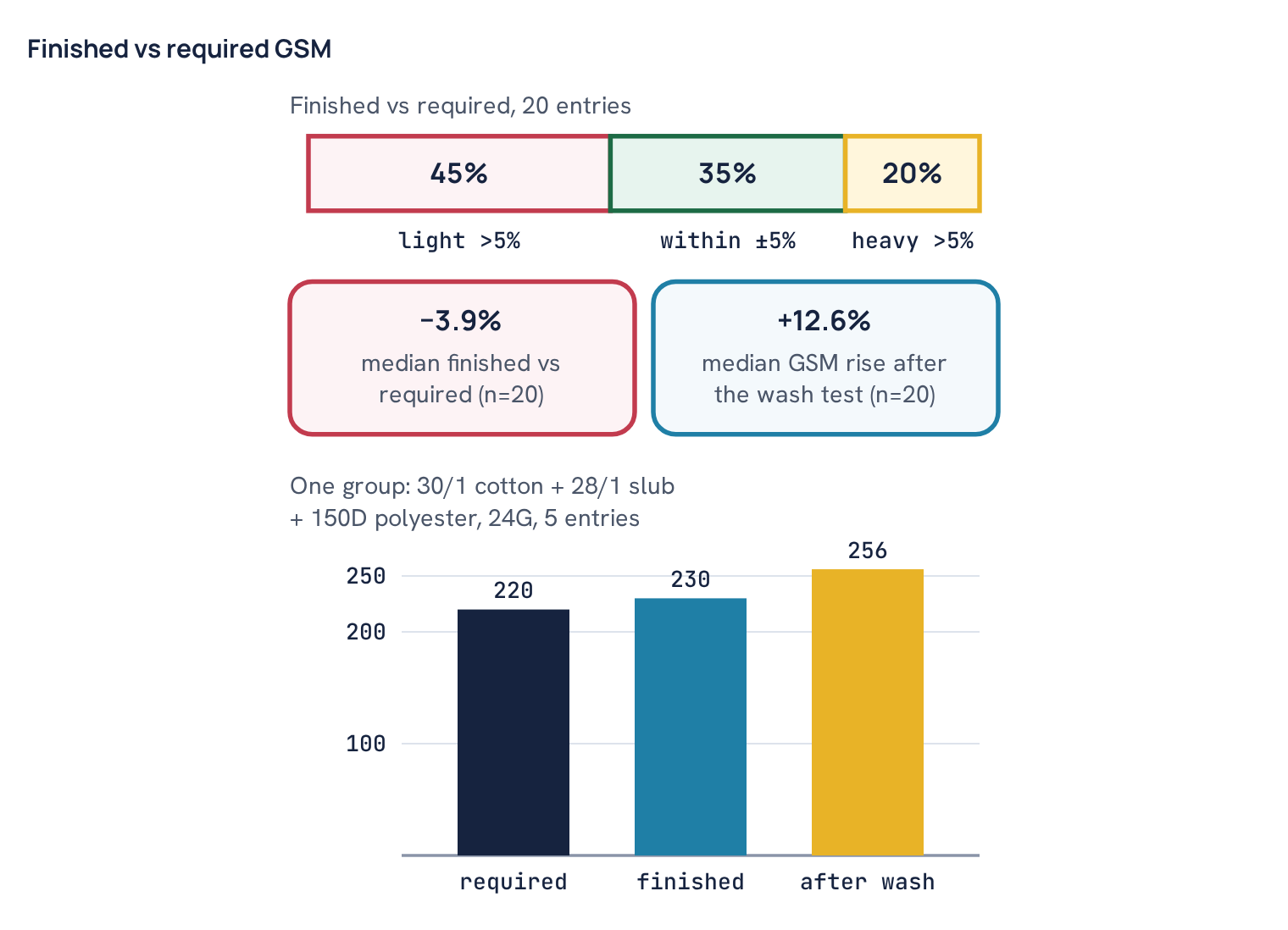
The after-wash figure is the important one. GSM rises a median of 12.6% after the dye-house wash test (n=20), more than the 8% we see for single jersey. Ottoman leaves the compactor still held open; much of the missing weight is already in the fabric and shows as soon as the ridges close in the wash.
Why ottoman shrinks in length and gains GSM
- Unequal course counts. The back layer is short and the face layer long. Any length tension pulls the face loops straight and opens the ridges. When the tension goes, the back pulls them shut again, and the fabric shortens.
- Tension in processing. Take-down in knitting, rope tension in dyeing, and length tension in de-watering and stenter all stretch the fabric in length.
- Too little overfeed. If the stenter and compactor do not push enough length back in, the fabric leaves the line long and light.
- The rib base. The tie course is rib, so the fabric also closes in width when it relaxes, especially if it was stretched wide on the stenter.
Our one summarised group is a reminder not to assume. In the dye-house wash test it shrank -7% in width and only -2% in length. That group contains polyester filament and was finished at 162 cm; we cannot say from five entries which factor drove it. What it does show is that ottoman can move in either direction, and the width must be planned as carefully as the length. Our buyer lab results, a separate test, showed small movement after one wash: median length +0.8% (slight growth) and width -1.4%, from only 3 reports.
Controlling GSM and length
Ottoman gives you more levers than jersey. Use them in this order:
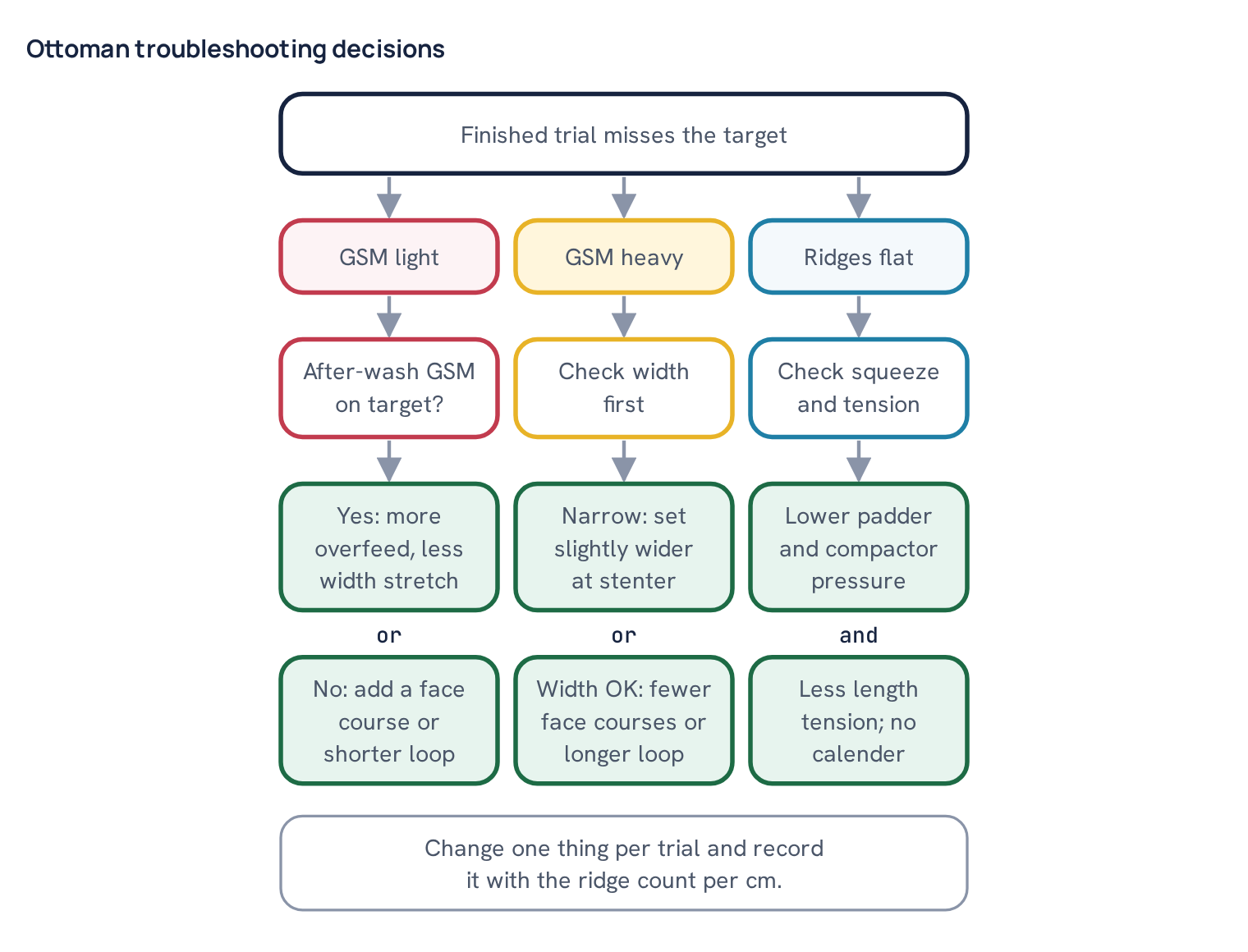
- Finishing first. If finished GSM is low but GSM after the wash test is on target or above, the fabric has enough yarn. Add stenter and compactor overfeed, reduce width stretch and length tension, and re-test.
- Ridge structure next. If both finished and after-wash GSM are low, add one face course to the repeat or shorten the face stitch length a little. If GSM is high, remove a face course or lengthen the loop, but check that the ridge look still matches the swatch.
- Stitch length of the tie course. A slightly longer tie loop lets the ridge sit lower and the fabric grow in length; a shorter one rounds the ridge and shortens the fabric. Change it in small steps and record the ridges per cm.
- Count last. Change count only when the structure cannot reach the target, because a new count also changes the ridge look and shade.
Worked example. Our 30/1 cotton, 28/1 slub and 150D polyester group was required at 220 GSM and finished at 230, 4.5% heavy and inside a ±5% tolerance. After the wash test it reached 256 GSM, 16% above the requirement. If the buyer tests GSM after washing, this quality will fail heavy. Ask which state the buyer tests in, then consider one fewer face course or a slightly wider set, and re-test both finished and after-wash GSM. A shrinkage allowance for cutting can be checked with the fabric shrinkage calculator.
Cotton, blends and elastane
Our ottoman data is too thin to split by fibre. As general practice, CVC and PC ottoman shrinks less and holds its ridge better than 100% cotton, and elastane ottoman pulls in hard, so heat-set width, stenter width and compaction must be planned together. Our knit GSM and shrinkage by fibre study compares the fibres across all fabric types.
Planning greige GSM and dia
- Fix the ridge structure from the buyer’s swatch: face courses per ridge and ridges per cm.
- Choose gauge and count, and start from the median finished result: expect a finished GSM a few percent below required and an after-wash GSM about 10 to 15% higher.
- Knit a short trial, rest it, and record greige GSM, dia and ridges per cm.
- Run it through the full bulk route, not a lab shortcut.
- Record finished GSM, width, ridges per cm and after-wash GSM, and write down the greige-to-finished ratios for the next order.
Testing the developed fabric
Only 3 ottoman test reports reached our desk, with between 1 and 5 results per test. That is too few to estimate fail rates. Reports that reach us are also more often the problem cases, so the table shows where to look, not what to expect in production.
| Test | Typical buyer requirement (varies by buyer) | Our lab reports (ottoman, 3 reports) |
|---|---|---|
| Dimensional stability (shrinkage) | Often within ±5% L and W after the stated wash | 0 fails in 5 results; median after one wash L +0.8%, W -1.4% (n=3) |
| GSM | Often ±5% of the required GSM | 2 fails in 3 results |
| Spirality | Often 5% maximum after washing | 0 fails in 5; all 0.0% |
| Bursting strength | A minimum in kPa set by the buyer | 0 fails in 3; median 226 kPa, range 129–500 kPa |
| Pilling | Often grade 3–4 minimum | 0 fails in 3; pilling 4–5, fuzzing 4 |
| Colour fastness to washing | Often 4 change, 3–4 staining | 1 fail in 3 |
| Colour fastness to rubbing | Often dry 4, wet 2–3 or 3 | 0 fails in 3; wet 3, 3 and 3–4 |
| Perspiration, water and light fastness | Set by the buyer | 0 fails (3 perspiration, 1 water, 1 light) |
| Fibre content | Within the label tolerance | 0 fails in 2 |
| pH | Often 4.5–7.5 | Not in our set |
Even from three reports, two points agree with the register. GSM is the test to watch: it failed in 2 of 3 results, matching the wide spread of finished GSM. And spirality is not a concern: all five results were 0.0%, as expected from a balanced double-bed structure. The one wash fastness fail is a reminder that ridges hold loose dye. Wet rubbing at 3 and 3–4 is close to the usual limit on deep shades. The bursting range of 129 to 500 kPa reflects different qualities, not a pattern.
The methods and fixes are in these guides:
- How to test shrinkage of knit fabric and shrinkage test fail: causes and remedies
- How to test GSM of knit fabric and GSM test fail: causes and remedies
- How to test spirality of knit fabric
- How to test bursting strength and how to test pilling (box and Martindale)
- Wet rubbing fastness fail: causes and remedies
When you cut a GSM test sample from ottoman, cut whole ridges. A sample cut across part of a ridge weighs differently from one that holds complete repeats, and the error is larger on tall ridges.
Development record sheet and troubleshooting
Record sheet template
Use one sheet per trial. The rows specific to ottoman are the cam chart and the ridge count.
| Stage | Record |
|---|---|
| Request | Buyer, style, required GSM and tolerance, finished width, composition, ridge swatch and ridges per cm, shade or yarn colours, wash care, test standard |
| Yarn | Count, fibre, spinning type, supplier and lot for each feeder position; filament denier; elastane denier |
| Knitting | Machine no., diameter, gauge, total feeders, cam chart (K/M per feeder for dial and cylinder), stitch length per yarn, yarn input tension, elastane draft, take-down, speed |
| Greige | Greige GSM, tubular dia, ridges per cm, roll weight, faults |
| Heat set / singeing | Temperature, time or speed, set width, overfeed; singeing yes/no and side |
| Wet process | Machine, batch load, pretreatment, enzyme yes/no, dye recipe and conditions, wash-off, softener |
| Stenter | Temperature, speed, set width, overfeed, squeeze pressure before it |
| Compactor | Overfeed, steam, pressure, exit width |
| Finished | Finished GSM, open width, ridges per cm, ridge look against swatch, GSM after wash test, shrinkage L/W, spirality |
| Lab tests | Each result against the requirement, pass or fail |
| Decision | Approved or adjust; what changes in the next trial and why |
Troubleshooting
The diagram covers the three most common complaints; the table adds the rest.
| Problem | Likely cause | What to change |
|---|---|---|
| Finished GSM low, after-wash GSM on target | Ridges held open; too little overfeed; stenter too wide | More stenter and compactor overfeed; less width and length tension |
| Finished and after-wash GSM both low | Too few face courses; face loop too long; count too fine | Add a face course or shorten the face stitch length |
| GSM high | Ridge too tall; fabric over-compacted or narrow | Remove a face course or lengthen the loop; reduce compaction; check width |
| Ridges flat or weak | High squeeze or compactor pressure; length tension; heat set while stretched; heavy softener | Lower pressures; more overfeed; heat set nearer relaxed width; lighter softener |
| Uneven or broken ridges | Feeder count not a multiple of the repeat; cam set wrongly; uneven yarn or elastane tension | Check cam chart and feeder count; equalise tensions |
| Width shrinkage high | Stretched wide on stenter; rib base closing | Set width nearer relaxed width; plan greige dia for it |
| Length shrinkage high | Fabric left long; too little compaction | Raise compactor overfeed; reduce tension in wet processing |
| Crease marks | Heavy load; high reel speed; sudden cooling | Lighter load; slower reel; controlled cooling |
| Weak wash fastness or wet rubbing | Loose dye trapped in ridges; poor wash-off; deep shade | More rinses and soaping; review depth and softener |
| Fuzz or pills on ridge crests | Hairy yarn; no singeing or enzyme | Combed or compact yarn; singe or bio-polish |
| Shade differs between ridge and ground (blends) | Polyester and cotton parts not matched | Balance disperse and reactive depths; check under the buyer’s light |
For lot-to-lot problems in bulk, see shade variation lot to lot and uneven and patchy dyeing.
Ottoman rib is a fabric of two layers that want different lengths. Decide the ridge from the buyer’s swatch, write down the cam chart, protect the ridge through finishing, and judge each trial on ridge count and after-wash GSM as well as finished GSM. Our records on this fabric are few, so record every trial fully.
Questions
How is ottoman rib knitted?
On a double-jersey machine. One feeder knits on both dial and cylinder to tie the layers, then several feeders knit on the cylinder only while the dial needles miss and hold their loops. The extra face courses buckle out into a horizontal ridge.
What controls the ridge height of ottoman?
Mainly the number of face-only courses in each repeat, for example 1 + 3 for a low ridge or 1 + 5 for a taller one. Stitch length, yarn and finishing tension also change how round the ridge looks.
Why is ottoman rib heavy?
Several face courses are packed into the length of one back course, and there is a back layer as well, so there are more loops per square centimetre than in plain rib on the same gauge.
Why does ottoman gain GSM after washing?
Finishing stretches the fabric and opens the ridges; in the wash the short back layer pulls them closed again. In our records ottoman GSM rose a median 12.6% after the dye-house wash test, while finished GSM was a median 3.9% below required.
How do I keep the ridges from flattening in finishing?
Use low squeeze pressure in de-watering, generous stenter overfeed at a width near the relaxed width, light compactor pressure and no calender, and heat set blends without stretching the ridges flat.
What is ottoman fabric?
Ottoman is a fabric with bold raised horizontal ribs. In knits, ottoman rib is a double-jersey fabric in which only one needle bed knits for several courses, so those courses bunch up into a raised ridge, then a tie course joins both beds again.

Textile engineer with 14+ years in dyeing and fabric development. He writes every guide on Dyeing Solution from real production work. Full profile