A step-by-step development guide for single jersey, spider, pointelle and design mesh: how tuck, miss and transfer make the holes, cam charts, polyester and cotton yarns, keeping holes open in finishing, hitting GSM and width, and testing, built on our records.
At a glance
73mesh entries in our register
-6%median finished vs required GSM
+6.8%median GSM rise after the wash test
66%mesh entries flagged heat set
Mesh is the knitted fabric with small open holes you see in football shirts, running vests, training tops and the lining of jackets and swim shorts. The holes let air and sweat out, so the fabric feels cool and dries fast. For a development engineer, the pattern matters as much as the weight: you must make the holes in knitting, keep them open through heat, dyeing and finishing, and still hit the buyer’s GSM and width. This guide follows the route from yarn to a tested fabric. It is built on our fabric register, which holds 73 mesh entries, and on the single mesh lab report that reached our desk. That is thin data, much thinner than for jersey or rib, so where the records run out we say so and give general practice, marked as typical.
New to development? Read the single jersey development guide first. Most mesh is single jersey with tuck or miss stitches added, so everything about yarn, stitch length and relaxation in that guide applies here too.
What mesh fabric is
A plain knit with planned openings
A plain single jersey is made only of knit loops, so the wales run straight and the loops sit evenly side by side. Mesh breaks that order on purpose. At chosen feeders, chosen needles do not knit. Either they tuck, taking the yarn into the hook but keeping the old loop, or they miss, taking no yarn at all. On some machines a loop is also transferred to the next needle. Each of these leaves the fabric with a spot where the loops are pulled apart, and repeated in a pattern, those spots become holes.
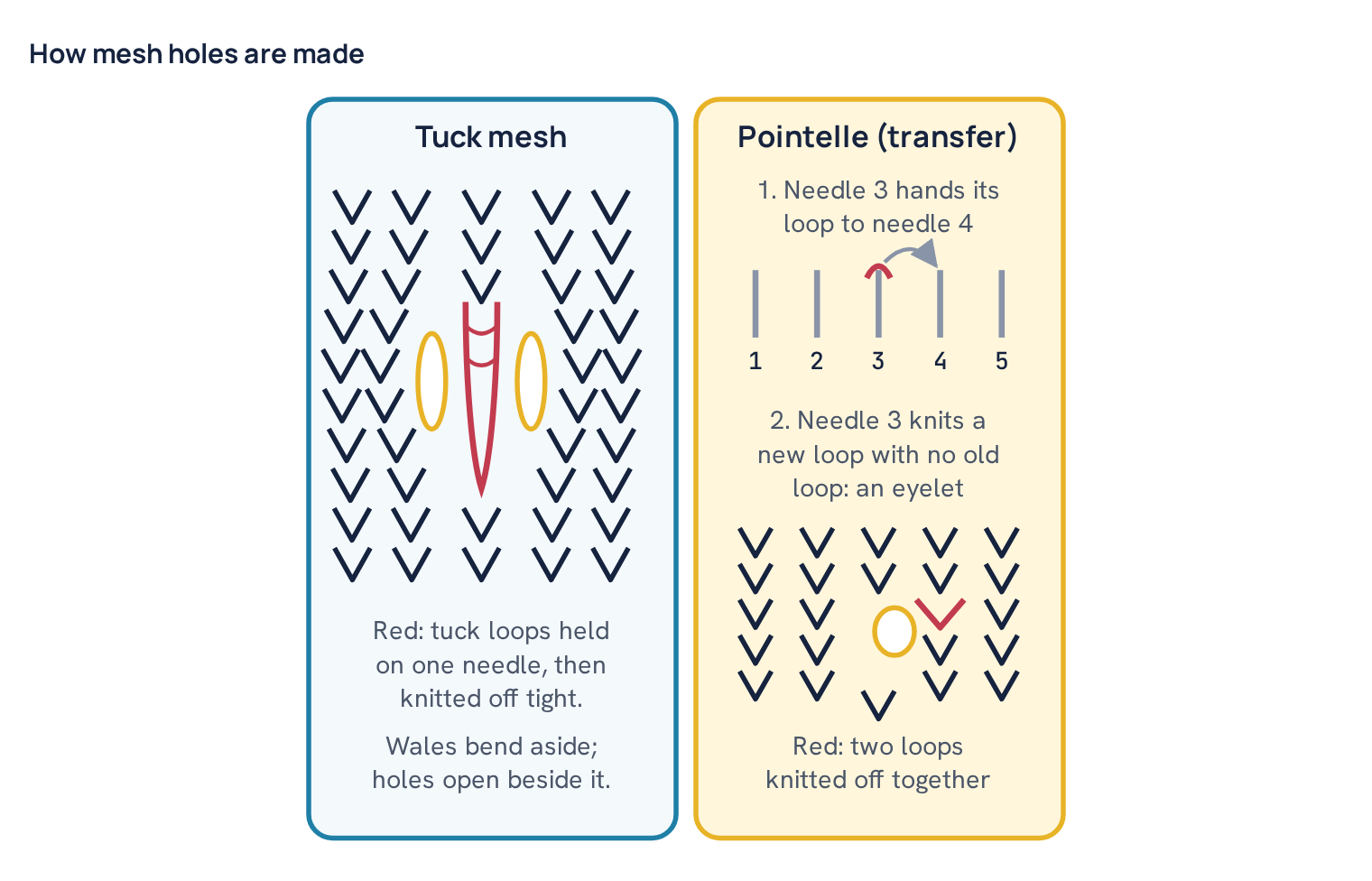
- Tuck mesh. The tucking needle holds two or three loops on its hook for a few feeders. When it finally knits, it pulls one new loop through all of them. The held loops are drawn tight and long, and they pull the neighbouring wales sideways. The space left beside them is the hole. This is the most common route for single jersey mesh and sports mesh.
- Miss mesh. A missing needle leaves a float behind it and its own loop is stretched over several courses. The wales on each side bunch together and leave a gap. Miss alone gives a smaller, less regular opening than tuck, so it is often combined with tuck.
- Transfer (pointelle) mesh. A needle hands its loop to a neighbour. At the next feeder the emptied needle starts a fresh loop with no old loop to pull it through, and a clean, round eyelet is left below it. This needs machines with transfer elements; see the design rib and pointelle guide.
Properties you must design around
- Openness and cover. Buyers judge mesh by the size, shape and spacing of the holes. Too small looks like plain jersey; too large shows skin.
- Lower strength per gram. A hole is a place with fewer yarns. For the same GSM, mesh has less yarn holding the fabric together than plain jersey, so bursting strength and seam strength need checking.
- Width instability. Tuck loops and floats pull the fabric in, and the holes can be stretched open or squeezed shut in finishing.
- Snagging. Long tuck loops and floats sit proud of the surface and are easily hooked, most visibly on smooth filament yarn.
- Edge curling and spirality. As a single-knit fabric, mesh curls at cut edges and can spiral, but tuck stitches tie the structure a little and usually reduce both compared with plain jersey.
The variants in our register
The register uses six mesh type names: MESH, SPIDER MESH, DESIGN MESH, POINTAL MESH, L/MESH and LY MESH. In everyday use they mean:
- Mesh (single jersey mesh). A regular tuck or tuck-and-miss mesh, the base of most sports and lining mesh.
- Spider mesh. A more open, web-like tuck mesh with larger holes. The exact construction varies by mill, so always ask for the buyer’s swatch.
- Design mesh. A mesh with a patterned arrangement of holes, such as stripes, checks or blocks of mesh next to plain areas.
- Pointelle mesh. Eyelets made by loop transfer, or a tuck mesh made to look like pointelle. The register spells it “pointal”.
- L/mesh and LY mesh. Mesh with elastane for stretch. Only 3 entries in our register carry elastane, so the stretch notes in this guide are general practice.
Mesh is used for sportswear bodies and panels, team jerseys, linings for shorts, swimwear and jackets, and summer tops in cotton or CVC.
Development inputs
Read the buyer’s request, and get the swatch
For mesh, a written request is never enough. Ask for a physical swatch or a clear photo with a scale, because “mesh 150 GSM” can mean a dozen different hole patterns. Then write down every requirement in one place:
- Finished GSM with a tolerance, often ±5%.
- Finished width, open width in cm or inches.
- Composition: 100% polyester, CVC or PC blend, 100% cotton, or with elastane.
- Hole pattern: size, shape and density, and which side is the face.
- Shade and light source.
- Functional finish: moisture wicking, quick dry, anti-odour or cooling, and the test that proves it.
- Wash care, which sets the shrinkage and fastness test conditions.
- Test requirements: dimensional stability, spirality, bursting, pilling, snagging, colour fastness, pH and fibre content.
Choosing the yarn
Polyester filament for sports mesh. Most sports and lining mesh is polyester filament, described by denier (grams per 9,000 m) and filament count: 75D/36F is 75 denier made of 36 filaments. More filaments of the same denier give a softer, more matt yarn and better wicking; fewer give a crisper, brighter one. Textured filament gives cover and a softer handle; flat filament gives a cleaner hole. Cooling or wicking polyester with a shaped cross-section is common in sportswear; describe it by function, not by trade name.
Spun polyester. Made from staple fibre, it gives a matt, cotton-like surface and bulk, often combined with a filament. Its weakness is pilling: strong polyester fibres keep pills anchored.
Cotton and CVC. Used for casual and summer mesh. Choose combed, ring or compact yarn for a clean hole and better pilling. CVC is more stable than cotton but needs two dye classes.
Twist and spirality. Spun yarns carry twist torque, which makes single-knit fabric spiral. Use knitting twist, not weaving twist. Filament yarns have little or no torque, which is one reason polyester filament mesh is easy to keep straight.
Elastane. Stretch mesh is made by plating a bare elastane filament with the main yarn, as in Lycra (elastane) single jersey. Elastane pulls the holes smaller, so the pattern must be designed more open to start with, and the fabric must be heat set.
Common mistake: switching from a 36-filament to a 72-filament yarn of the same denier between trial and bulk because it is in stock. GSM stays about the same, but the handle, sheen, hole look and shade depth all change.
Knitting
Machine, gauge and diameter
Mesh in our register is knitted mostly on single jersey circular machines. The gauge split is 24 gauge in 54 of 73 entries, then 18 gauge (13), 14 gauge (4) and one entry each at 20 and 28 gauge. The coarser gauges give bigger, bolder holes; 24 gauge is the standard for filament sports and lining mesh. The diameters are 34 inch (50 entries), 36 inch (12), 40 inch (7) and 38 inch (2). One entry is recorded at 84 inch, which is unusual for a circular machine; check such an entry before you use it as a reference.
Mesh finishes wide in our records, about 184 to 216 cm open width for the main polyester qualities.
Worked example. A 34 inch, 24 gauge machine has 34 × 3.1416 × 24 = about 2,564 needles. Our main 75D/36F mesh finishes at a median 185 cm, which means about 2,564 ÷ 185 = 13.9 wales per cm in the finished fabric. If the stenter is set 10 cm narrower, there are about 14.7 wales per cm and the holes become narrower and taller.
Cam notation and needle set-out
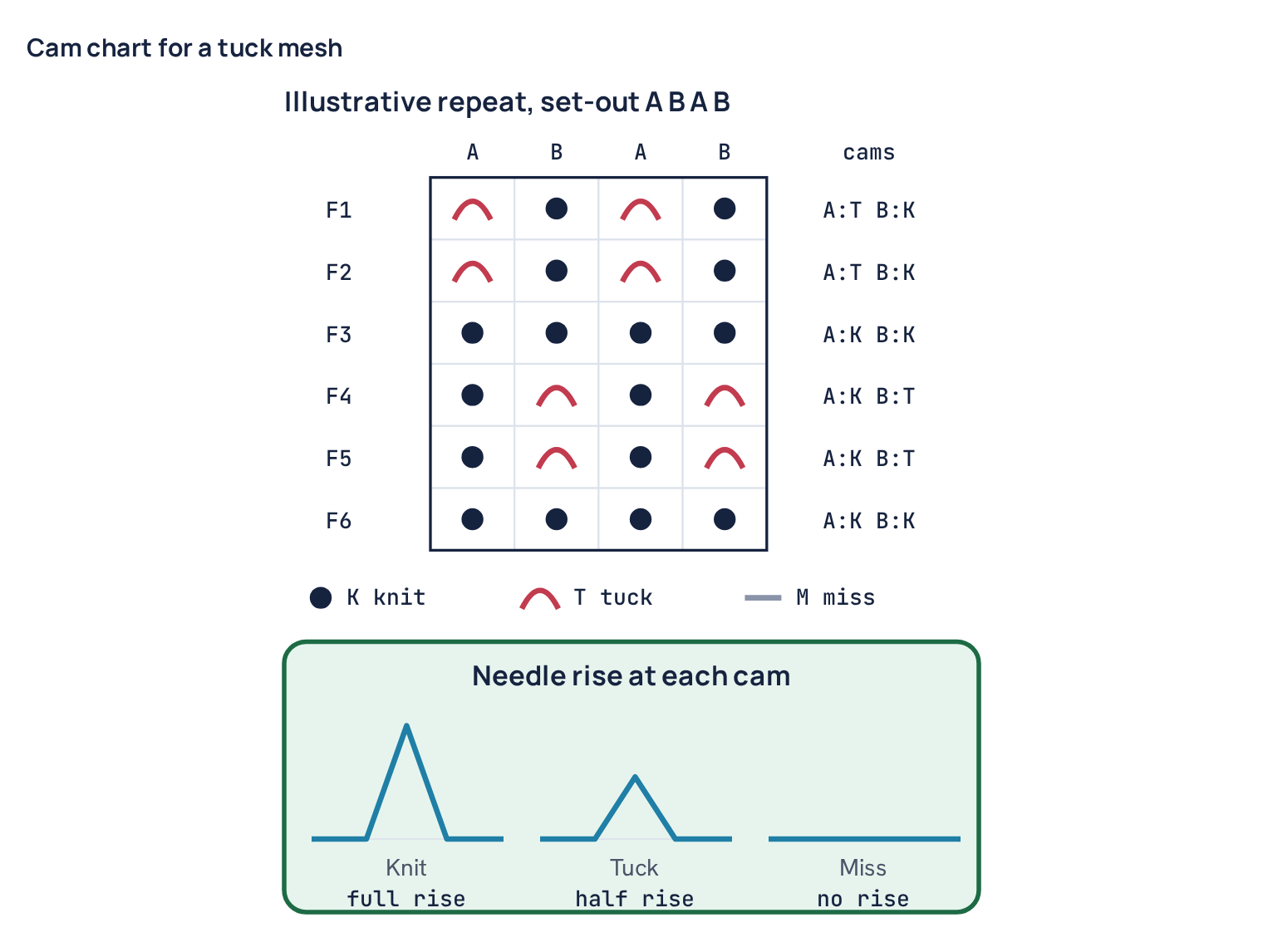
A mesh pattern is written as a cam chart. The columns are needles, the rows are feeders, and each square shows what that needle does at that feeder: knit, tuck or miss. The cam at each feeder decides how high the needle rises:
- Knit cam. The needle rises fully, the old loop slides below the latch, the needle takes new yarn and pulls it through. A new loop is formed and the old one is cast off.
- Tuck cam. The needle rises only part of the way. The old loop stays on the latch, the hook takes the new yarn, and both sit in the hook together.
- Miss cam. The needle does not rise. It takes no yarn, and the yarn floats behind it.
Needles are divided into groups by butt position, called tracks. A typical mesh uses two tracks, A and B, set out alternately, with the cam for each track set independently at each feeder. The diagram shows one illustrative repeat; a design mesh may use more tracks or electronic needle selection. Tuck structures of the same family are covered in the pique development guide.
Three rules of thumb help when you design or copy a repeat:
- Limit successive tucks. Each extra tuck adds a loop to the hook. Typically two or three tucks in a row on one needle is the practical limit, and four is possible only with fine, strong yarn. More than that strains the yarn and needle hook and causes holes and press-offs.
- Knit between tuck blocks. An all-knit feeder between tuck blocks anchors the structure and keeps the fabric stable.
- Offset the blocks. Moving the tuck from track A to track B in the next block spreads the holes evenly, like bricks in a wall. Tucking the same needles every block makes vertical stripes, not holes.
Stitch length, yarn and GSM
The basic GSM formula for knitted fabric is GSM = (courses per cm × wales per cm × stitch length in mm × yarn tex) ÷ 100. For filament yarn, tex = denier ÷ 9, so 75 denier is about 8.3 tex and 100 denier about 11.1 tex. For spun yarn, tex = 590.5 ÷ Ne count, so 22/1 spun polyester is about 26.8 tex.
Tuck and miss stitches change how much yarn each feeder lays and how far the fabric draws in, so use the formula as a cross-check on a measured trial, not as a design tool on its own. The knit GSM from stitch length calculator and the GSM calculator are useful for that check.
Our recorded mesh qualities
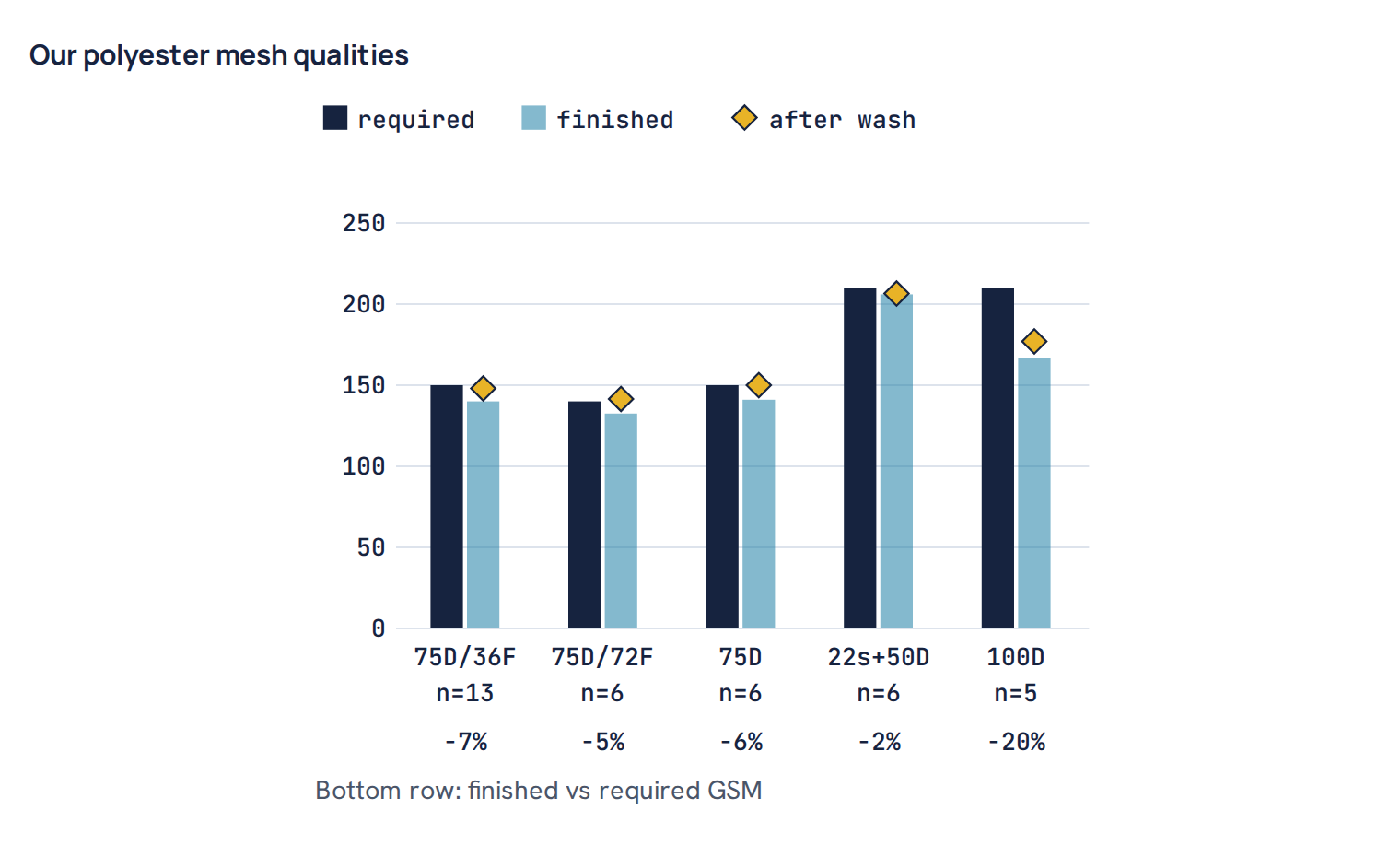
The register yarn strings are varied, so only five constructions have enough entries for medians. All five are polyester. Stitch length is shown per yarn as recorded, in yarn order, because the register records two values for these qualities.
| Yarn | Gauge | Entries | Stitch length per yarn as recorded, mm | Required GSM | Finished GSM | GSM after wash | Finished dia, cm | Shrink L / W, % | Spirality, % |
|---|---|---|---|---|---|---|---|---|---|
| 75D/36F polyester filament | 24G | 13 | 2.65 + 2.45 | 150 | 140 (135–142) | 148 | 185 | -2 / -2 | 2 |
| 75D/72F polyester filament | 24G | 6 | 2.60 + 2.40 | 140 | 132.5 | 141.5 | 190 | -3 / -2 | 2 |
| 75D polyester filament | 24G | 6 | 2.60 + 2.42 | 150 | 141 | 150 | 183.5 | -3.5 / -2 | 2 |
| 22/1 spun polyester + 50D polyester filament | 24G | 6 | 3.00 + 1.75 | 210 | 206 | 206.5 | 207 | -2 / -2.5 | 2 |
| 100D polyester filament | 24G | 5 | 2.70 + 2.55 | 210 | 167 | 177 | 216 | -6 / -3 | 2 |
Four points stand out. First, the three 75 denier qualities are a settled standard: 24 gauge, stitch lengths around 2.60 to 2.65 mm and 2.40 to 2.45 mm, 140 to 150 GSM required, about 185 to 190 cm finished. Second, they finish 5 to 7% light but recover almost exactly to the required GSM after the dye-house wash test, so the yarn content is right and the fabric is leaving finishing stretched. Third, the spun polyester plus filament quality reaches 210 GSM with a coarser spun yarn and finishes almost on target. Fourth, the 100 denier quality is a warning: it finishes at 167 against 210 GSM and is still only 177 GSM after the wash test. That is not a relaxation problem; the construction is too light for the request, and it also has the highest length shrinkage, -6%, in the table. Only 5 entries sit behind it, so treat it as a signal, not a rule.
Elastane and multi-yarn feeding
When two yarns run in a mesh, record which yarn goes to which feeder, and its input tension. In a plated stretch mesh, the elastane is fed through a positive feeder at a controlled draft and laid behind the main yarn. Uneven draft from feeder to feeder shows as bars, as uneven hole size and as uneven GSM. See barre in knit fabric for the wider list of causes.
Machine settings to record
- Machine number, diameter, gauge, feeders, the full cam chart and the needle set-out.
- Yarn type, denier and filament count or Ne count, lot and supplier for each feeder.
- Stitch length per yarn, measured on the greige fabric, plus the cam or stitch setting.
- Yarn input tension, and elastane draft if used.
- Take-down tension and machine speed. Mesh needs steady take-down; too little lets tuck loops pile up, too much pulls the holes long.
- Greige tubular dia, greige GSM and roll weight.
Greige inspection
Check the greige for the usual faults and also for the mesh pattern itself. A broken or bent needle butt in a tuck track makes a whole wale knit instead of tuck, and the pattern shows a straight line with no holes. A wrong cam at one feeder makes a course line across the tube. Compare the greige with the approved swatch under good light before the roll goes to the dye house, because no finishing will repair a pattern fault.
Dyeing and finishing route
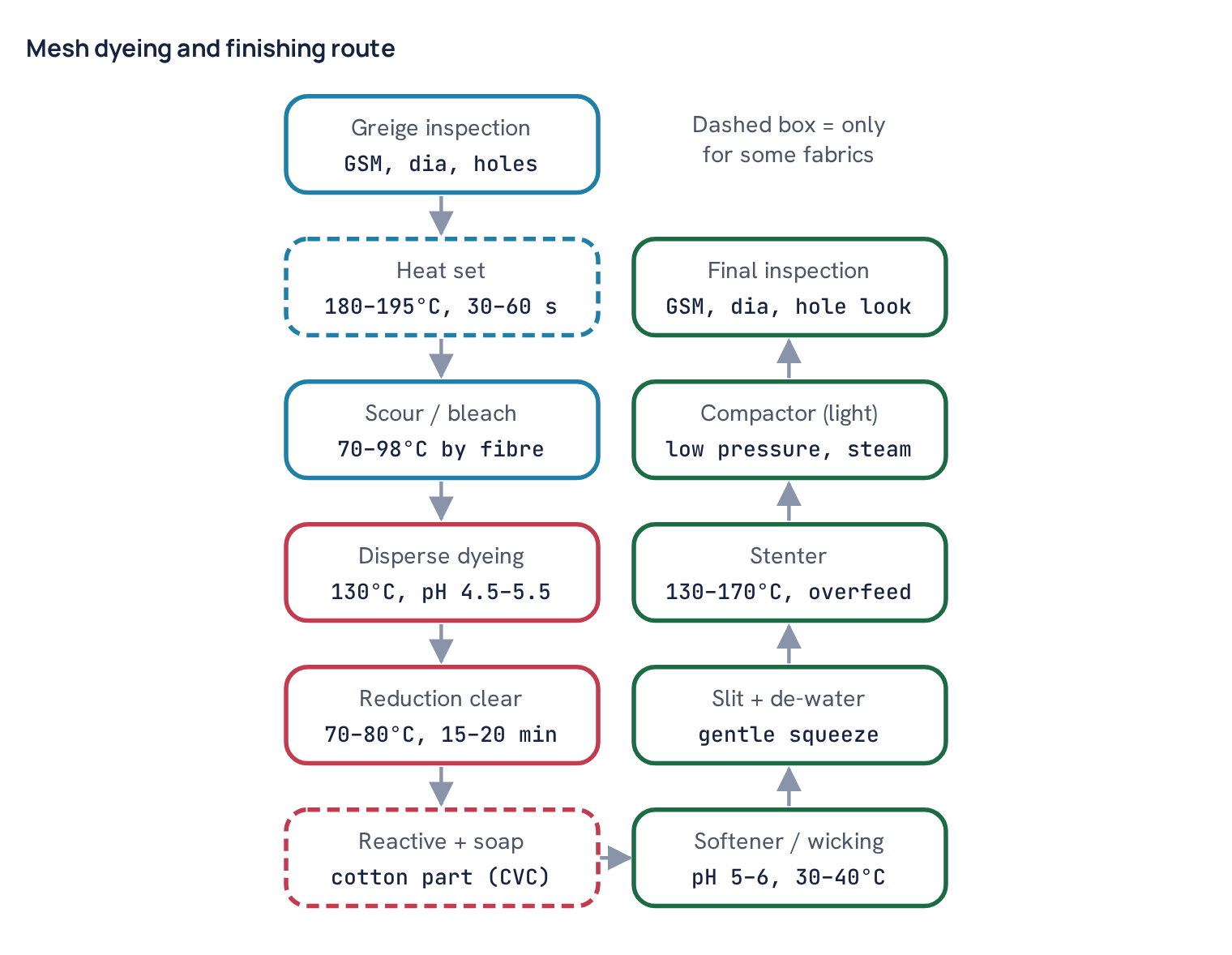
All 73 mesh entries in our register went through an open-width route with stenter and compactor. Two thirds of them, 48 of 73, carry a heat-set flag, which fits a fabric that is mostly polyester. A small number carry a singeing flag: 4 entries in all, one of them heat set and singed on both sides. A shorter overview is in the mesh fabric dyeing and finishing flowchart; for transfer eyelets see also the pointelle flowchart. The parameters below are typical ranges and vary with dyes, chemicals and machines.
Heat setting
Polyester and elastane mesh is heat set on the stenter, typically at 180 to 195°C for 30 to 60 seconds, at a width close to the planned finished width. This locks the hole geometry, controls width and shrinkage and reduces creasing in the jet. It fixes whatever shape the fabric has on the pins, so set the width with care.
Singeing
Singeing burns off protruding fibres for a sharper hole and less fuzz. It suits cotton and spun yarn mesh; on polyester it can melt fibre ends into hard beads, so use it with care.
Pretreatment and dyeing
- Scouring. Polyester mesh needs a scour to remove knitting oil and spin finish, typically with a detergent and mild alkali at 70 to 80°C. Cotton and CVC mesh need a full scour and bleach, typically 95 to 98°C for 45 to 60 minutes, as in the 100% cotton knit dyeing process.
- Disperse dyeing. Polyester is dyed with disperse dyes at high temperature, typically 130°C for 30 to 60 minutes at pH 4.5 to 5.5, with a dispersing and levelling agent. Control the heating rate through the critical range to keep the shade level; see level dyeing and uneven shades.
- Reduction clearing. For medium and dark shades, surface disperse dye is removed with sodium hydrosulphite and caustic soda, typically at 70 to 80°C for 15 to 20 minutes. Poor clearing shows later as poor rubbing and wash fastness.
- CVC and cotton. The cotton part is dyed with reactive dyes after the polyester, then soaped and neutralised. The full two-step method is in the CVC fabric dyeing process.
A crease set into filament mesh at 130°C is permanent. Load the jet lightly, keep enough nozzle flow, and cool slowly, typically 1 to 2°C per minute, before draining. More on this in crease marks in knit dyeing.
Finishing that keeps the holes open
The holes are made in knitting but they can be lost in finishing. The aim is to dry and set the fabric at the width where the holes look like the approved swatch, with no more tension than needed.
- Softener or functional finish. Sports mesh usually gets a hydrophilic finish for wicking instead of, or as well as, a softener, typically at pH 5 to 6. A heavy silicone softener feels good but can block wicking, so test both.
- Slitting and de-watering. Slit along the marked line and squeeze gently. Hard squeezing flattens tuck loops and closes holes.
- Stenter. Dry and set at the planned width with moderate overfeed, typically 130 to 160°C for cotton and 150 to 170°C for polyester, staying below the heat-set temperature so the set shape is not changed. Too narrow and overfed, the holes close and the fabric gets heavy; too wide, the holes stretch into slots and the GSM falls.
- Compactor. Use light pressure and steam. Strong compaction squeezes the holes shut and gives a flat, papery look on polyester.
Hitting finished GSM and width
What our records show
Across 71 mesh entries with both values, the median finished GSM is 6% below the required GSM. Only 23% of entries finish within ±5% of the target. 59% finish more than 5% light, and 18% finish more than 5% heavy. After the dye-house wash test, the GSM rises by a median of 6.8% (70 entries).
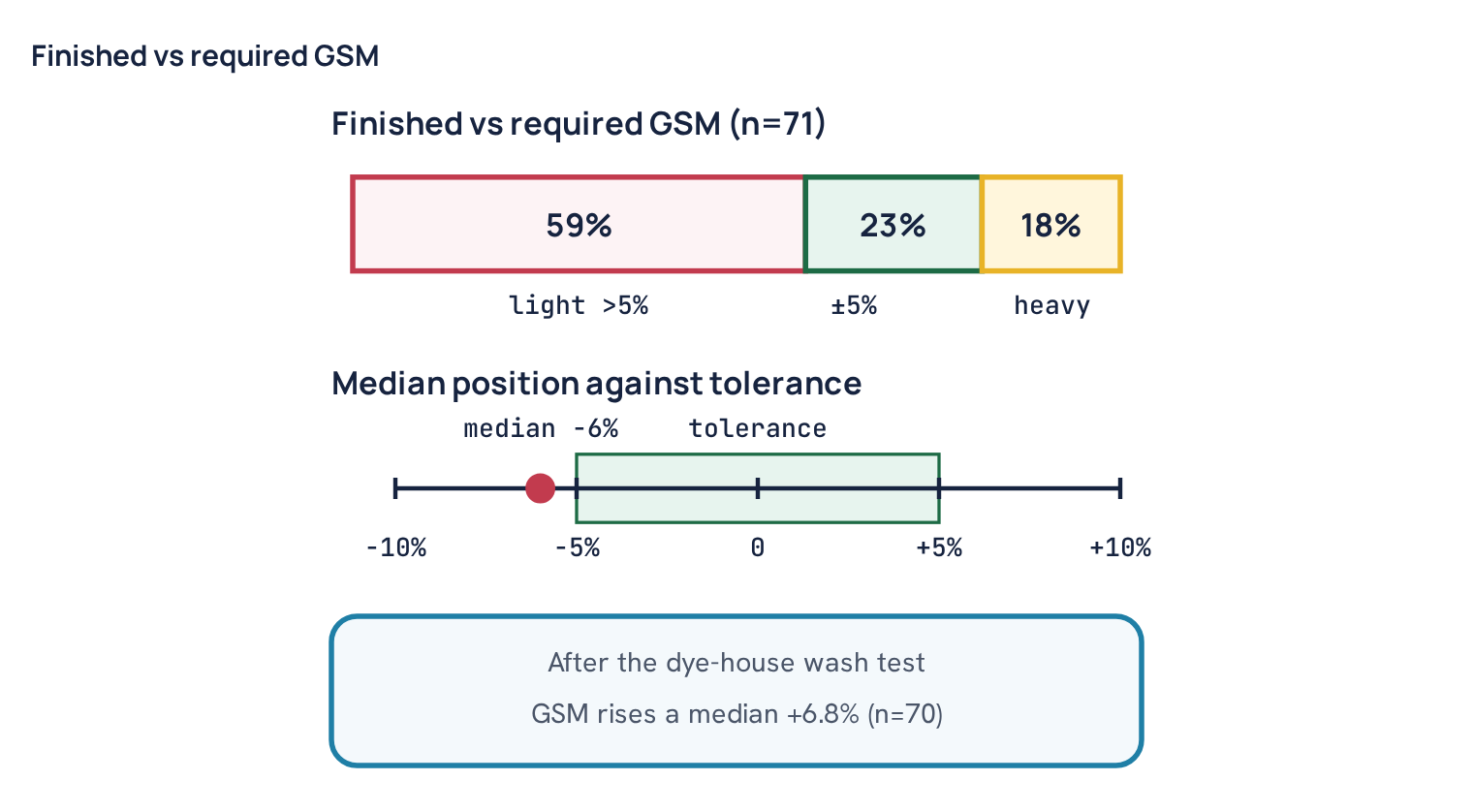
As in jersey, most mesh leaves finishing lighter than required and gains weight once washed and relaxed. For the 75 denier qualities the fix is in finishing, not in the yarn.
Why mesh finishes light
- Width stretch. Mesh opens easily in width. Setting the stenter wide to show clear holes and meet the width target takes weight out of every square metre.
- Length stretch. The fabric is pulled in length through the jet, the squeezer and the stenter. Without enough overfeed the length stays in the fabric.
- Heat set too wide. Polyester remembers the width it was heat set at. If it was set wide, it finishes wide and light, and the wash test does not fully bring it back.
- Construction too light. Where the after-wash GSM is still low, as with our 100 denier quality, the fabric does not have enough yarn and finishing cannot add it.
Shrinkage and spirality
The dye-house wash test shows low shrinkage for the polyester mesh in our table: -2 to -3.5% in length and -2 to -2.5% in width for the 75 denier and spun-plus-filament qualities, with the 100 denier quality the exception at -6% length. Spirality is 2% for all five. Heat-set polyester is dimensionally stable. Cotton and CVC mesh behave more like jersey of the same yarn; our register has only 10 cotton mesh entries, too few for separate medians. For a wider comparison see the knit GSM and shrinkage by fibre study, and estimate the effect on cut size with the fabric shrinkage calculator.
How to plan greige GSM and dia
- Start from the closest quality in the table: gauge, stitch length per yarn and finished dia.
- Plan for the light finish. If similar mesh finishes 6% light, aim the greige construction so that the finished fabric, not the after-wash fabric, lands within tolerance.
- Decide the heat-set width together with the finished width, because for polyester the heat set largely fixes it.
- Run the trial through the full bulk route, then measure finished GSM, width, hole look and GSM after the wash test.
- If finished GSM is low but after-wash GSM is on target, set narrower with more overfeed. If both are low, change the construction: a shorter stitch length, a heavier yarn or a denser tuck repeat.
- Record greige to finished ratios for GSM and dia so the next order starts closer.
Common mistake: pulling mesh wide on the stenter to make the holes look bigger at approval. The swatch passes the look test and fails the GSM test, and the holes close again after the first wash.
Testing the developed fabric
Only one mesh lab report reached our desk, so our lab evidence is very limited. It passed every test except one of its two shrinkage results. The table gives typical buyer requirements, which vary by buyer, beside that one report.
| Test | Typical buyer requirement (varies by buyer) | Our lab report (mesh, 1 report) |
|---|---|---|
| Dimensional stability (shrinkage) | Often within ±3 to ±5% after the stated wash | 2 results, 1 fail; after one wash L -2.1%, W -4.6% |
| Spirality | Often 5% maximum after washing | 2 results, both 0.0% |
| GSM | Often ±5% of required | Pass |
| Bursting strength | A minimum in kPa set by the buyer | 361 kPa, pass |
| Pilling (box method) | Often grade 3–4 minimum | Pilling 4–5, fuzzing 4 (length direction), pass |
| Snagging | Often grade 3–4 minimum on filament sportswear | Not in our report |
| Colour fastness to washing, perspiration | Often 4 change, 3–4 staining | Pass |
| Colour fastness to rubbing | Often dry 4, wet 3 | Wet 4, pass |
| Wicking / quick dry | Buyer’s own method and limit | Not in our report |
| pH, fibre content | pH often 4.5–7.5; fibre content within label tolerance | Fibre analysis pass; pH not reported |
Bursting strength
The holes reduce the yarns in the test area, so mesh is weaker than plain jersey of the same weight. Strong polyester filament mesh usually passes; our single result is 361 kPa. Watch cotton mesh, especially after enzyme or heavy bleaching. Test methods and fixes are in how to test bursting strength and bursting strength fail: causes and remedies.
Pilling and snagging
Filament mesh rarely pills, because there are no loose fibre ends, but it snags. Spun polyester and CVC mesh can pill badly, and the pills stay attached because polyester fibre is strong. Singeing, low-hairiness yarn and a tighter construction help pilling. For snagging, keep tuck loops and floats short and avoid very long stitch lengths on the face. Test methods are in pilling test: box and Martindale; snagging is usually tested with a mace-type snag tester, to the buyer’s method.
Colour fastness
For polyester mesh, rubbing and wash fastness depend mostly on reduction clearing; some buyers also ask for sublimation fastness. For CVC, check staining on the multifibre strip.
The testing methods and fixes for the common tests are covered in these guides:
- How to test shrinkage of knit fabric and shrinkage test fail: causes and remedies
- How to test spirality of knit fabric and spirality test fail: causes and remedies
- How to test GSM of knit fabric and GSM test fail: causes and remedies
- Wet rubbing fastness fail: causes and remedies
Worked example. A buyer asks for 150 GSM mesh in 75D/36F polyester. Our register median for that quality finishes at 140 GSM, 6.7% light and outside a ±5% tolerance, and returns to 148 GSM after the dye-house wash test. Before changing the stitch length, check the heat-set and stenter widths against the planned 185 cm finished width, set a little narrower with more overfeed, and re-test finished GSM, width and the hole look against the swatch.
Development record sheet and troubleshooting
Record sheet template
Use one sheet per trial and keep the request values and the actual values side by side. For mesh, add the cam chart and a photo of the hole pattern at each stage.
| Stage | Record |
|---|---|
| Request | Buyer, style, required GSM and tolerance, finished width, composition, hole pattern (swatch reference), shade, functional finish, wash care, test standard |
| Yarn | For each feeder: denier and filament count or Ne count, flat or textured, spun or filament, supplier, lot, elastane denier |
| Knitting | Machine no., diameter, gauge, feeders, cam chart, needle set-out, stitch length per yarn (measured), input tension, elastane draft, take-down, speed |
| Greige | Greige GSM, tubular dia, roll weight, pattern check against swatch, faults |
| Heat set / singeing | Temperature, speed or dwell time, set width, overfeed; singeing yes/no and sides |
| Wet process | Machine, load, scour recipe, dye recipe, dyeing temperature, time and pH, cooling rate, reduction clearing, reactive step for CVC |
| Finish | Softener or wicking finish, pH, squeeze pressure |
| Stenter | Temperature, speed, set width, overfeed |
| Compactor | Overfeed, steam, pressure, exit width |
| Finished | Finished GSM, open width, GSM after wash test, shrinkage L/W, spirality, hole photo, shade result |
| Lab tests | Each result against requirement, pass/fail |
| Decision | Approved / adjust; what changes in the next trial, and why |
When the holes are wrong
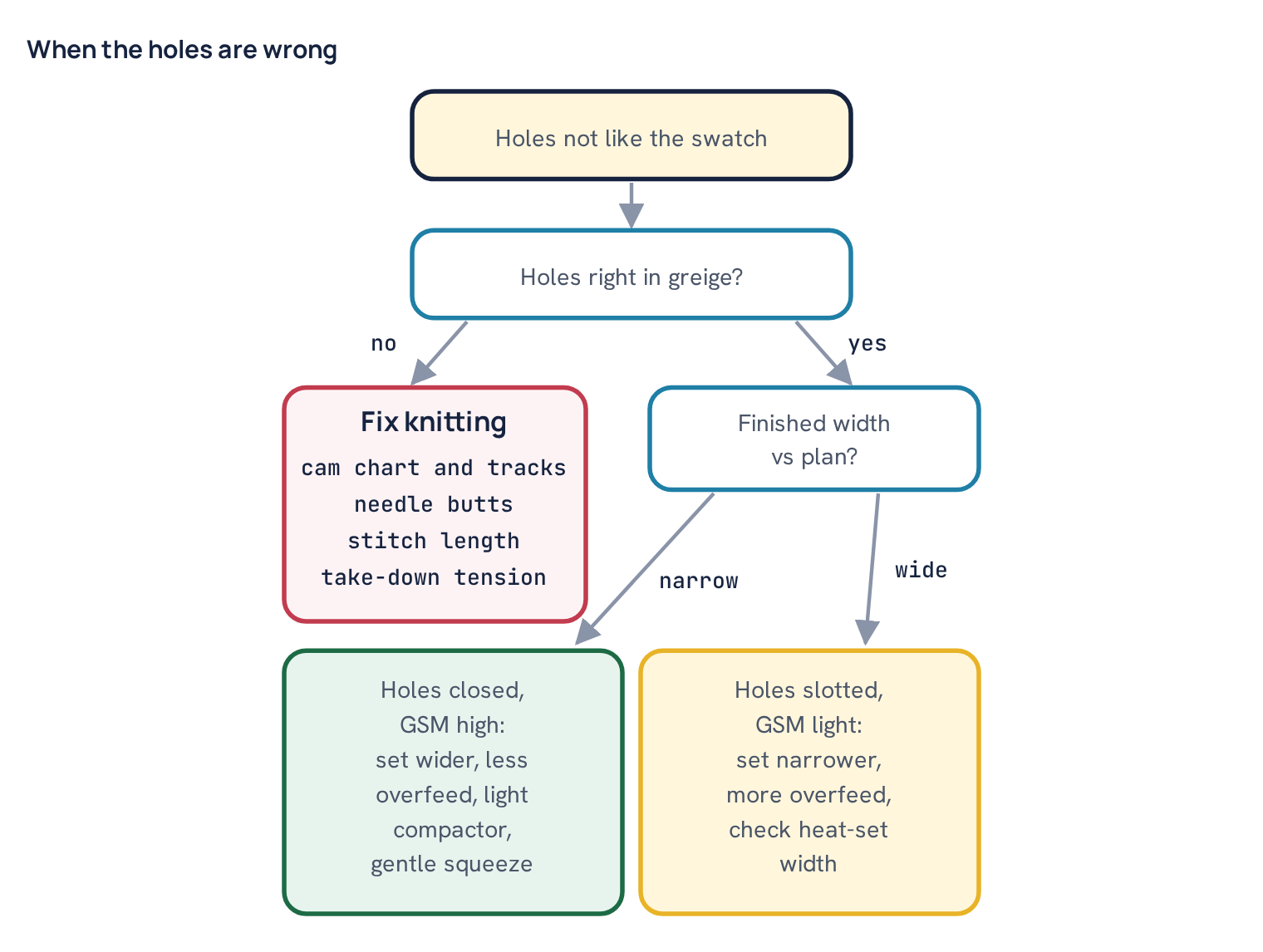
The most mesh-specific complaint is “the holes are not like the swatch”. The decision diagram below separates knitting causes from finishing causes, so you change the right thing first.
Troubleshooting
| Problem | Likely cause | What to change |
|---|---|---|
| Finished GSM low, after-wash GSM on target | Set too wide on heat set or stenter; length left in the fabric | Narrower set width, more stenter and compactor overfeed |
| Finished and after-wash GSM both low | Construction too light for the request | Heavier yarn, shorter stitch length or denser tuck repeat |
| Holes small or closed | Too few tucks per block; over-compaction; set too narrow; hard squeezing | Check cam chart; less compactor pressure; set wider; gentler de-watering |
| Holes stretched into slots | Over-width on stenter or heat set; heavy take-down | Narrower set width; lower take-down tension |
| Line with no holes along a wale | Broken or wrong needle butt in a tuck track | Replace needle; check set-out |
| Course line across the fabric | Wrong cam at one feeder; one yarn end of a different lot | Check cam chart; use one yarn lot |
| Press-off or holes in tuck areas | Too many successive tucks; weak yarn; high input tension | Fewer successive tucks; stronger yarn; lower tension |
| Crease marks on polyester | Heavy load; fast cooling; low fabric speed in jet | Lighter load, slow cooling, more nozzle flow; heat set before dyeing |
| Poor wet rubbing on dark polyester | Weak reduction clearing | Stronger or repeated reduction clear; check dye selection |
| Pilling on spun polyester or CVC mesh | Hairy yarn; loose construction | Lower-hairiness or compact yarn; singeing; tighter construction |
| Snags on filament mesh | Long tuck loops or floats on the face | Shorter floats; tighter stitch; textured yarn |
| Shade varies roll to roll | Mixed filament lots or merge numbers; uneven heat set | One yarn merge per order; even heat-set temperature; see lot-to-lot shade variation |
Mesh development comes down to a cam chart that makes the right holes, a heat-set and stenter width that holds them, and enough yarn to meet the GSM after finishing, not only after washing. Our mesh data is thin, so record every trial fully.
Questions
How are the holes in mesh fabric made?
Mostly with tuck stitches: a needle holds two or three loops for a few feeders, then knits them off tight, pulling the neighbouring wales aside so a hole opens. Miss stitches give smaller openings, and pointelle mesh moves a loop to the next needle to leave an eyelet.
What yarn is used for sports mesh?
Mostly polyester filament. In our register the main qualities are 75 denier filament (36 or 72 filaments) on 24 gauge for 140 to 150 GSM, and 22/1 spun polyester with 50 denier filament for 210 GSM.
Why does mesh finish below the required GSM?
Mainly because it is heat set and stentered wide and leaves finishing with length still in it. In our records mesh finishes a median 6% light, and GSM rises a median 6.8% after the wash test.
How do I keep the holes open in finishing?
Heat set and stenter at the width that matches the approved swatch, de-water gently and use light compactor pressure. Too narrow or over-compacted closes the holes; too wide stretches them into slots and makes the fabric light.
Does polyester mesh need heat setting?
Usually yes. Heat setting, typically 180 to 195°C for 30 to 60 seconds, fixes the hole geometry and width and reduces shrinkage and creasing. In our register 48 of 73 mesh entries carry a heat-set flag.

Textile engineer with 14+ years in dyeing and fabric development. He writes every guide on Dyeing Solution from real production work. Full profile