A step-by-step development guide for polo shirt pique: cam charts for single and double Lacoste, yarn and stitch length, collars and cuffs, yarn-dyed stripes, finishing for GSM and width, and testing, built on our real development records.
At a glance
604pique and Lacoste entries in register
-5%median finished vs required GSM
+11.4%median GSM rise after the wash test
8 of 23shrinkage lab results that failed
Pique is the fabric of the polo shirt. Its small raised cells give a textured, breathable surface that keeps its shape better than plain jersey. To the buyer it is often just “200 GSM pique, 100% cotton”. To the development engineer it is a tuck-stitch construction with its own cam chart, a tighter stitch length than jersey, a wider fabric on the same needles, a high length shrinkage, and a flat-knit collar and cuff that must match the body in shade, shrinkage and feel. This guide follows the route from yarn to a tested pique and builds it on real figures: 604 pique and Lacoste entries in our fabric register, covering plain, single and Lycra Lacoste, micro, Lycra, flat-back, design, yarn-dyed and interlock pique, and 21 test reports on pique from our lab reports. Where a value comes from general practice rather than our records, it is marked as typical. The basic ideas (stitch length, gauge, the GSM formula) are explained in the single jersey fabric development guide.
What pique and Lacoste are
A single jersey with tuck stitches
Standard pique is knitted on a single jersey circular machine, with one bed of needles. The difference from plain jersey is that some needles tuck instead of knitting on some feeders. The needles are set out in two tracks, called A and B here, in an alternating order: A, B, A, B round the cylinder. Each feeder has a cam for each track, and each cam is set to knit or to tuck. The repeat of feeder settings, read down the feeders, is the cam chart, and it is the real definition of the fabric.
- Knit. The needle rises fully, the old loop slides below the latch, the needle takes the new yarn and pulls it through the old loop. A normal loop is formed.
- Tuck. The needle rises only part of the way. It takes the new yarn into its hook, but the old loop stays in the hook too. The new yarn becomes a tuck loop that is not pulled through anything, and the old loop becomes a held loop that stays on the needle until the next knit.
When that needle knits again, it pulls the new loop through both the held loop and the tuck loop together. The held loop has been stretched over two or more courses, and the tuck loop lies at the back of the fabric in an open arc. That is the whole secret of pique.
Cam notation: single and double Lacoste
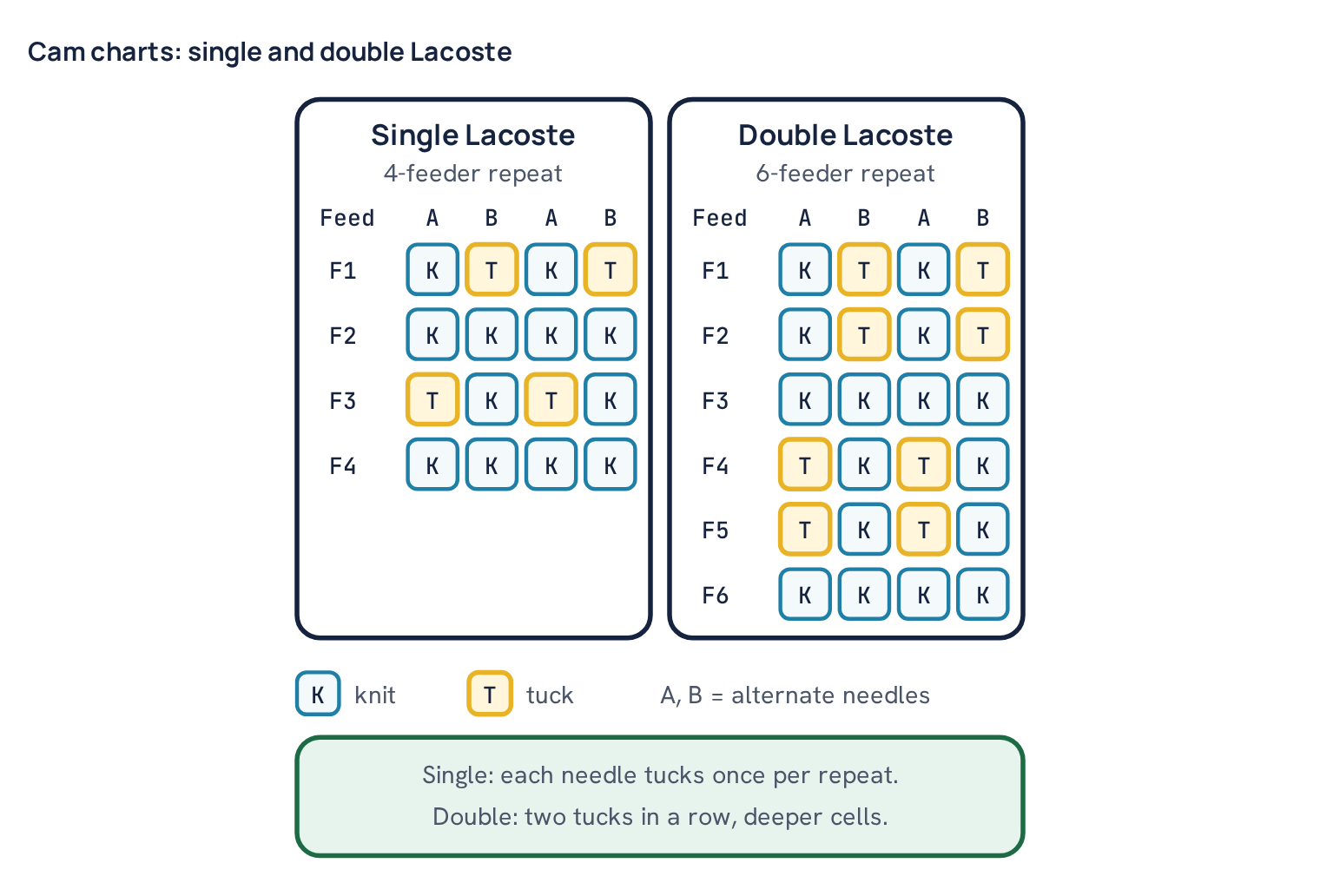
The two classic constructions are below, read feeder by feeder for needle tracks A and B. K is knit and T is tuck.
- Single Lacoste (single pique): a 4-feeder repeat. Feeder 1: A knit, B tuck. Feeder 2: A and B knit. Feeder 3: A tuck, B knit. Feeder 4: A and B knit. Each needle tucks once in the repeat, and the tucks move from one track to the other, so the cells sit in a staggered pattern.
- Double Lacoste (double pique): a 6-feeder repeat. Feeders 1 and 2: A knit, B tuck. Feeder 3: all knit. Feeders 4 and 5: A tuck, B knit. Feeder 6: all knit. Each needle tucks on two courses in a row, so the held loop is stretched over three courses and the cell is deeper and bolder.
Mills and textbooks do not agree on names. Some call the 4-feeder repeat “single pique” and others “single Lacoste”; some call a 2-feeder cross-tuck (A knit B tuck, then A tuck B knit) “pique”. In some markets “double pique” also means a double-knit fabric made on a rib or interlock machine. Our register lists that one separately as interlock pique, and it develops more like interlock (see the interlock fabric development guide). The safe rule: never knit from the name. Agree the cam chart with the knitting master and write it on the record sheet.
Why the tuck gives cells, width and weight
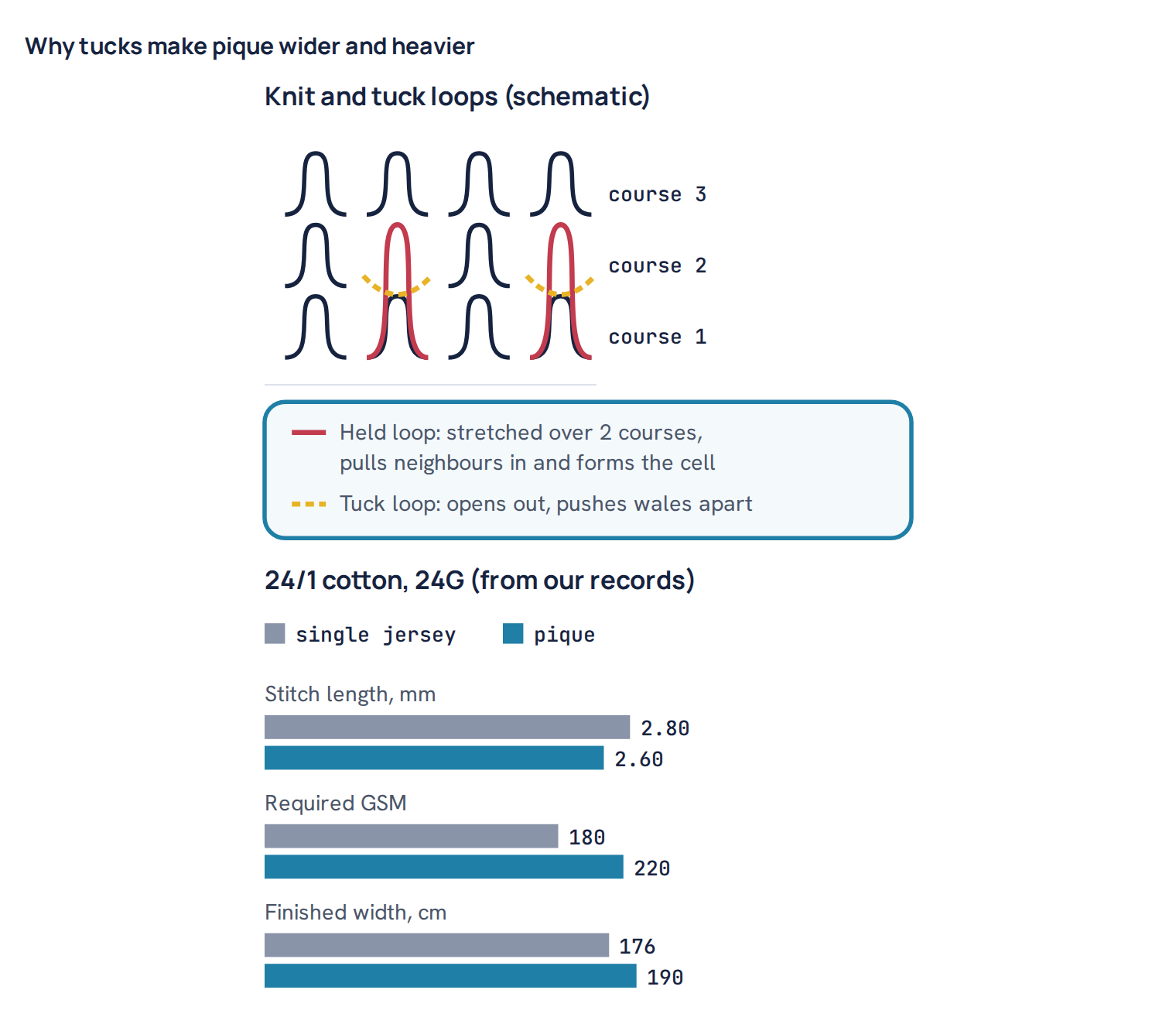
- The cellular surface. A held loop is stretched over two or three courses, so it pulls the knit loops next to it towards it. Between the held loops the fabric bulges, and a small cell forms. In single Lacoste the cells are small and staggered; in double Lacoste each held loop is longer, so the cells are deeper. The side with the tuck loops, the technical back, carries the clearer texture, and in many polo garments that side is worn outside. Confirm the effect side with the buyer.
- A wider fabric. A tuck loop is not pulled through another loop, so nothing holds it closed. It tends to open out and push the wales on either side apart. The same number of needles therefore gives a wider fabric than plain jersey.
- A heavier, thicker fabric. The held loops draw the courses closer together, so there are more courses per centimetre, and the tuck loops add yarn without adding fabric length. More yarn per square metre means a higher GSM and a thicker hand.
Our records show this clearly. In the single jersey guide, 24/1 cotton single jersey on 24 gauge is knitted at a median 2.80 mm for a required 180 GSM and finishes about 176 cm wide. The same 24/1 cotton knitted as pique on 24 gauge runs at a median 2.60 mm, for a required 220 GSM, and finishes about 190 cm wide. The pique is shorter in stitch length, about 22% heavier and wider, and most pique in the register is knitted on smaller cylinders: 30 inch (280 entries) and 28 inch (226 entries), with fewer on 34, 36 and 32 inch.
The pique family
The register covers these variants. The table describes each in general terms; the construction details vary between mills.
| Variant | What it is | Development points |
|---|---|---|
| Single pique / single Lacoste | 4-feeder knit-tuck repeat, small staggered cells | The base polo fabric; most entries are plain pique |
| Double pique / double Lacoste | 6-feeder repeat, two tucks in a row on each track | Bolder cells, heavier and wider than single at the same count |
| Micro pique | Pique structure with smaller cells, usually a finer gauge and count | Smoother look; finer yarn makes pilling and GSM control more sensitive |
| Lycra pique / Lycra Lacoste | Elastane plated with the cotton, full or half feed | Needs heat setting; width and GSM move a lot after relaxing |
| Flat-back pique | Textured face with a smoother reverse; constructions differ by mill | Agree which side is the face; record the cam chart |
| Design pique | More cam tracks or needle selection for patterned cells | Longer repeats; record needle set-out and cam chart in full |
| Yarn-dyed pique | Stripes or checks from dyed yarn | Stripe repeat must fit the cam repeat; colour fastness of the yarn rules |
| Interlock pique | Double-knit pique on a rib or interlock machine | Develops like interlock; heavier and more stable |
New to pique? Our short guide what is pique fabric explains pique for polo shirts, micro pique and how pique differs from jersey, in plain words. This guide goes on to the development details.
Development inputs
Read the buyer’s request
A pique request usually comes as part of a polo programme, so it has more parts than a jersey request. Write down in one place the finished GSM and tolerance (often ±5%), the open width, the construction name with a physical swatch if possible (because names differ), the composition and any organic, recycled or extra-long-staple claim such as pima, the yarn quality (combed, compact, singed or mercerised), the shade and light source, the collar and cuff specification (size, structure, tipping colours), the wash care, and the test list.
Choosing the yarn
Count. In our records the cotton pique qualities run from 22/1 Ne for about 235 GSM, through 24/1 and 26/1 for 200 to 220 GSM, to 30/1 for about 180 GSM. Pique does not need a coarser count than jersey; it builds a heavier fabric from a similar count, because of the tucks. A 26/1 count that gives a 170 GSM jersey gives a 200 GSM pique.
Combed, compact and pima. Polo fabric is judged on its surface, so combed yarn is normal and compact yarn is common. Compact yarn has fewer protruding fibres, which gives clearer cells, less pilling and a cleaner shade. Our register has separate compact rows at 26/1 and 28/1. One frequent quality is recorded as 24/1 cotton with 26/1 pima cotton, an extra-long-staple cotton used for a softer, more lustrous fabric.
CVC and PC. About one fifth of the register entries (117) are CVC or PC pique, and 27 more combine CVC or PC with elastane. The polyester adds strength and stability but needs a disperse dyeing step and often heat setting.
Twist and spirality. Residual torque in a single yarn leans the wales, as in jersey. A twist multiplier (αe) of roughly 3.2 to 3.8 is typical for cotton knitting yarn and varies by spinner. The tucks help hold the wales, so pique tends to show less spirality than plain jersey, but a high-twist lot still causes problems.
Singeing and mercerising. Some premium polo qualities are singed (passed over a flame to burn off surface fibres) or mercerised (treated with strong caustic soda for lustre and dye uptake). In our register 84 pique entries carry a singeing note and 8 a mercerised note. Include them in the trial if bulk will have them.
Common mistake: developing the body pique on one yarn lot and letting the collar section knit the flat-knit collars from another supplier’s yarn. Small differences in count, twist and whiteness show up as a shade and lustre mismatch at the neck.
Knitting
Gauge and diameter
Pique in our register is knitted mostly on 24 gauge (400 entries), then 28 gauge (114), with smaller numbers on 18, 16 and 20 gauge. The 24 gauge machines carry the 22/1 to 30/1 cotton qualities; 28 gauge carries the finer yarn and the Lycra pique with 32/1 cotton. The coarse gauges are used for heavier constructions.
The needle count sets the width. A machine has diameter in inches × π × gauge needles. Because the tucks push the wales apart, pique has fewer wales per cm than jersey and comes out wider.
Worked example. A 28 inch, 24 gauge machine has 28 × 3.1416 × 24 = about 2,111 needles. If the finished pique is 185 cm wide, that is about 2,111 ÷ 185 = 11.4 wales per cm. A cotton jersey of similar count usually finishes nearer 13 wales per cm, so on the same machine it would be only about 162 cm wide. This is why pique for a 180 to 190 cm width can be knitted on 28 and 30 inch cylinders.
Stitch length, count and GSM
The basic relationship is the same as for any weft knit: GSM = (courses per cm × wales per cm × stitch length in mm × yarn tex) ÷ 100, with tex = 590.5 ÷ Ne. In pique, though, the tuck feeders and the knit feeders take different amounts of yarn, and the courses and wales per cm depend strongly on the tuck structure. Treat the formula as a guide and the records as the real starting point. The knit GSM from stitch length calculator and the GSM calculator are useful for first estimates, but always confirm with a trial.
The stitch length recorded for pique is the average yarn per needle over the course, measured on the greige. For two-yarn qualities the register writes one value per yarn, in yarn order; for 24/1 cotton there are three such entries, with a median stitch length per yarn as recorded of 2.74 + 2.64 mm.
A useful check is the tightness factor, √tex ÷ stitch length in mm. For the main cotton pique rows it works out at about 1.8 to 1.9, at the tight end of the single jersey band. Pique is knitted tight on purpose: a loose pique has weak, flat cells and grows in length.
Count, gauge, stitch length and GSM from our records
The table shows the main pique qualities in our register, with medians. Stitch length has the interquartile range (the middle half of entries) in brackets. Required GSM is the buyer’s target; finished dia is the open width after finishing.
| Yarn | Gauge | Entries | Stitch length, mm | Required GSM | Finished dia, cm |
|---|---|---|---|---|---|
| 22/1 cotton | 24G | 27 | 2.70 (2.65–2.75) | 235 | 190 |
| 24/1 cotton | 24G | 54 | 2.60 (2.60–2.62) | 220 | 190 |
| 24/1 cotton + 26/1 pima cotton | 24G | 25 | 2.55 (2.55–2.55) | 220 | 182 |
| 26/1 cotton | 24G | 71 | 2.58 (2.55–2.60) | 200 | 185 |
| 26/1 compact cotton | 24G | 11 | 2.60 (2.60–2.60) | 190 | 180 |
| 28/1 cotton | 24G | 30 | 2.55 (2.50–2.58) | 200 | 179 |
| 28/1 compact cotton | 24G | 13 | 2.50 (2.50–2.50) | 190 | 180 |
| 30/1 cotton | 24G | 12 | 2.50 (2.50–2.50) | 180 | 166 |
| 32/1 cotton + 40 denier elastane, half feed | 28G | 29 | 2.70 (2.70–2.70) | 220 | 200 |
| 32/1 cotton + 40 denier elastane (feed not noted) | 28G | 12 | 2.70 (2.70–2.70) | 215 | 199 |
Three things stand out. First, the stitch length band for cotton pique is very narrow, 2.50 to 2.70 mm across all counts, and the middle half of entries often sits on a single value. Second, the cotton pique qualities are almost all on 24 gauge, so GSM is steered mainly by count, not by gauge. Third, the Lycra pique runs at a longer 2.70 mm on 28 gauge, yet reaches 215 to 220 GSM from a finer 32/1 count, because the elastane pulls the fabric together after knitting.
Lycra pique: plating and feed
Lycra (elastane) pique is plated in the same way as Lycra jersey: a bare elastane filament is fed with the cotton into the same hook, kept on the reverse side. The biggest quality in our register uses 40 denier elastane with 32/1 cotton at half feed, meaning elastane on every second feeder. With a 4-feeder repeat, make sure the elastane always falls on the same feeders of the repeat. Uneven elastane tension shows as bars and as uneven width, so record the draft or tension setting on every feeder that carries elastane. The Lycra single jersey development guide covers elastane feeding and heat setting in more detail.
Machine settings to record
Record everything a single jersey trial needs (machine, gauge, feeders, yarn lots, measured stitch length, input tension, take-down, greige GSM and dia), plus the cam chart for every feeder in the repeat, the needle set-out by track, the elastane feed and draft, and for yarn-dyed pique the stripe sequence feeder by feeder. The full list is in the record sheet at the end.
Greige inspection
Check the greige for wrong cam settings first, because a single cam set to knit instead of tuck leaves a vertical or diagonal line of flat cells round the whole roll. Then look for holes, needle lines, drop stitches, elastane breaks, oil stains and barre. Barre in pique often looks like a band of slightly different cell depth rather than a colour band; see barre in knit fabric. Measure greige GSM and tubular dia after the roll has rested for some hours.
Collars, cuffs and yarn-dyed stripes
Flat-knit collars and cuffs
The polo collar and cuff are not cut from fabric. They are knitted to shape on a flat (V-bed) knitting machine, usually in 1×1 rib or a similar rib structure, with a finished edge and often one or more tipping stripes. They follow a different route from the body, so they must be made to match. The general rib ideas are covered in the rib fabric development guide; for collars, match these points to the body:
- Yarn. The same fibre, the same spinner and ideally the same lot as the body. Any difference in whiteness or lustre shows after dyeing.
- Shade. The surest way is to dye collars with the body, in mesh bags in the same batch, where the process allows. Otherwise use the same recipe and dye lots and match to the approved body lot. Rib reflects light differently from pique cells, so judge the pair as a garment, under the buyer’s light source.
- Shrinkage. Collar length shrinkage must be close to the body neckline shrinkage, or the collar seam puckers or waves after washing. Wash a collar and a body panel together and measure both.
- Tipping fastness. A navy tipping on a white collar stains the ground if it bleeds. Use well-washed tipping yarn and check staining in wash and perspiration tests.
Yarn-dyed pique
Yarn-dyed pique is knitted from yarn already dyed on packages, so the colour is fixed before knitting and the fabric is not piece-dyed. Three points need care.
- Stripe repeat and cam repeat. A single Lacoste repeats every 4 feeders and a double Lacoste every 6. Plan stripe heights in whole multiples of the cam repeat, so each colour band holds complete cells and the colour change does not fall in the middle of a cell.
- Stripe height after finishing. The height of a stripe in cm depends on the finished courses per cm. With length shrinkage of 6 to 10.5% in our cotton pique records, the stripe height moves by the same proportion, so plan the greige stripe and the compaction together.
- Finishing route. No bleaching, which would attack the colours. A mild scour or wash, then softener, stenter and compactor. Test the yarn’s fastness before knitting.
Dyeing and finishing route
All 604 pique entries in our register went through the same open-width route with stenter and compactor. The parameters below are typical starting points. A short overview is in the pique and Lacoste dyeing and finishing flowchart. The full wet processes are in 100% cotton knit dyeing process, CVC fabric dyeing process and cotton elastane (Lycra) knit dyeing process.
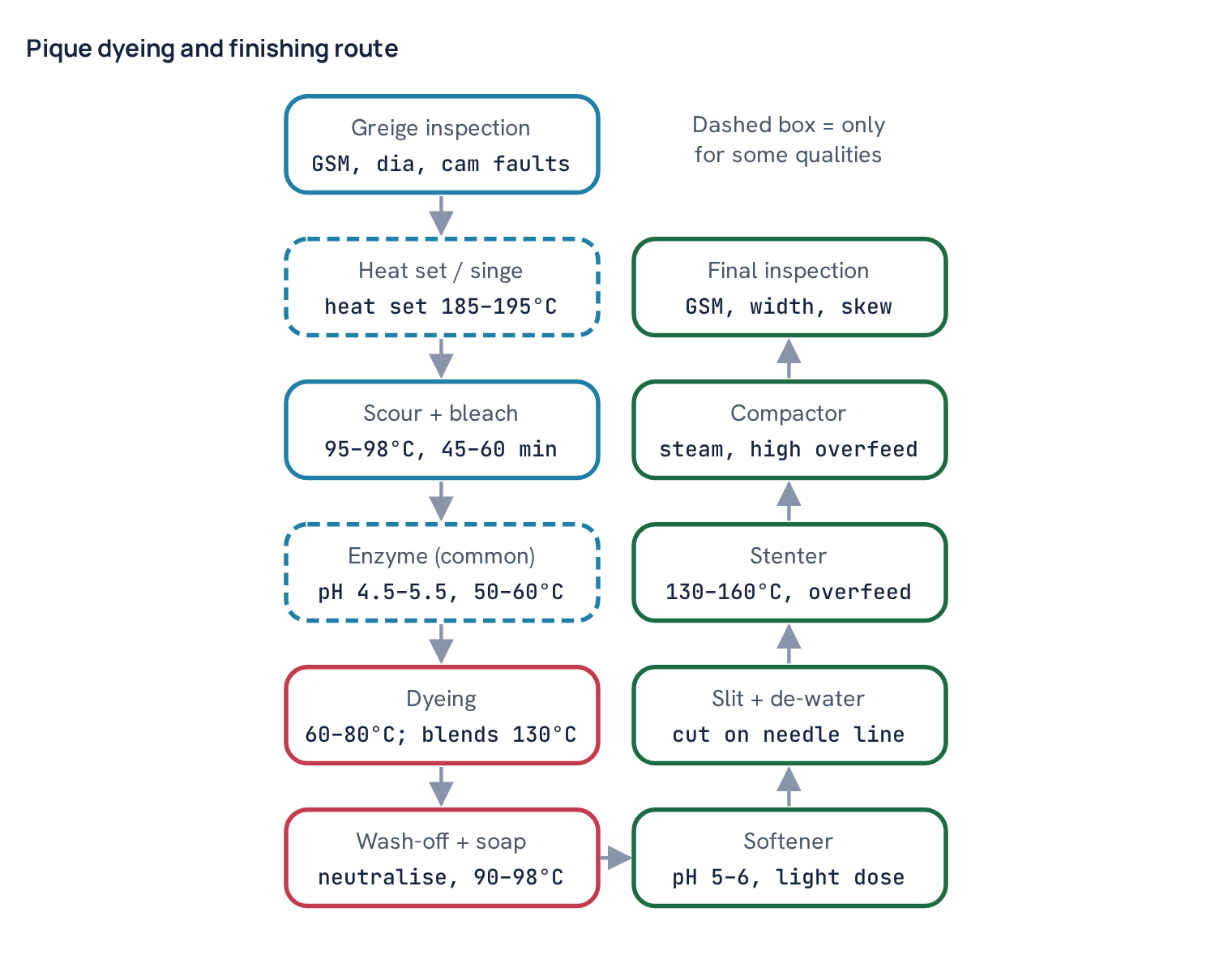
- Heat setting. About 30% of pique entries carry a heat-set flag, more than the elastane share (112 of 604, about 19%), so some non-elastane qualities are heat set too. Typical: 185 to 195°C for 30 to 60 seconds, at a width planned for the later relaxation.
- Singeing (when specified). Gas singeing before pretreatment removes surface fibres; it must be even across the width.
- Scouring and bleaching. Typically 95 to 98°C for 45 to 60 minutes with caustic soda and peroxide. Pique holds liquor in its cells, so rinse well.
- Enzyme bio-polishing. Very common on polo pique: acid cellulase at about pH 4.5 to 5.5 and 50 to 60°C for 45 to 60 minutes, then deactivate. It costs some weight and bursting strength.
- Dyeing. Reactive dyes for cotton, fixation typically 60 to 80°C at about pH 10.5 to 11 (see how reactive dyes work); blends add a disperse step near 130°C at pH 4.5 to 5.5, with reduction clearing. For unlevel dyeing and creasing see level dyeing and uneven shades and crease marks in knit dyeing.
- Wash-off and softener. Soap near the boil, then softener at about pH 5 to 6. A heavy softener can flatten the cell look.
- Slitting and stenter. Slit on the needle line and feed with the cell rows straight. Stenter typically 130 to 160°C with overfeed, never hotter than the heat setting for Lycra pique. Width stretch costs GSM.
- Compactor. The key step for pique: steam and overfeed push length back to cut shrinkage and set GSM. Too little leaves pique light; too much crushes the cells.
Hitting finished GSM and width
What our records show
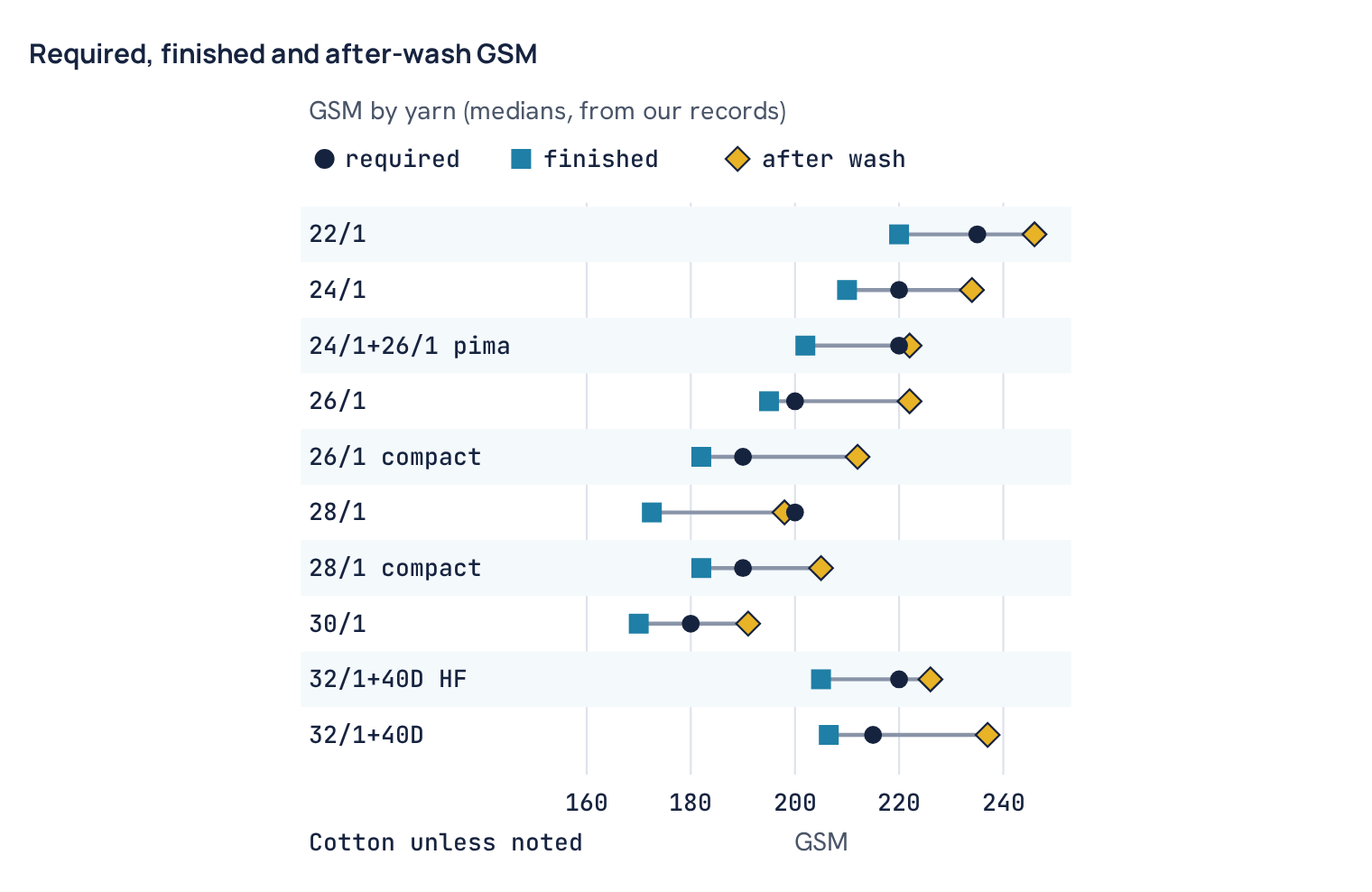
Across 587 pique entries with both values, the median finished GSM is 5% below the required GSM. Only 48% finish within ±5%, 50% finish more than 5% light, and only 2% finish more than 5% heavy. After the dye-house wash test, the GSM rises by a median of 11.4%, which is more than the roughly 8% rise for single jersey. Pique leaves the finishing range with a lot of length still stretched in.
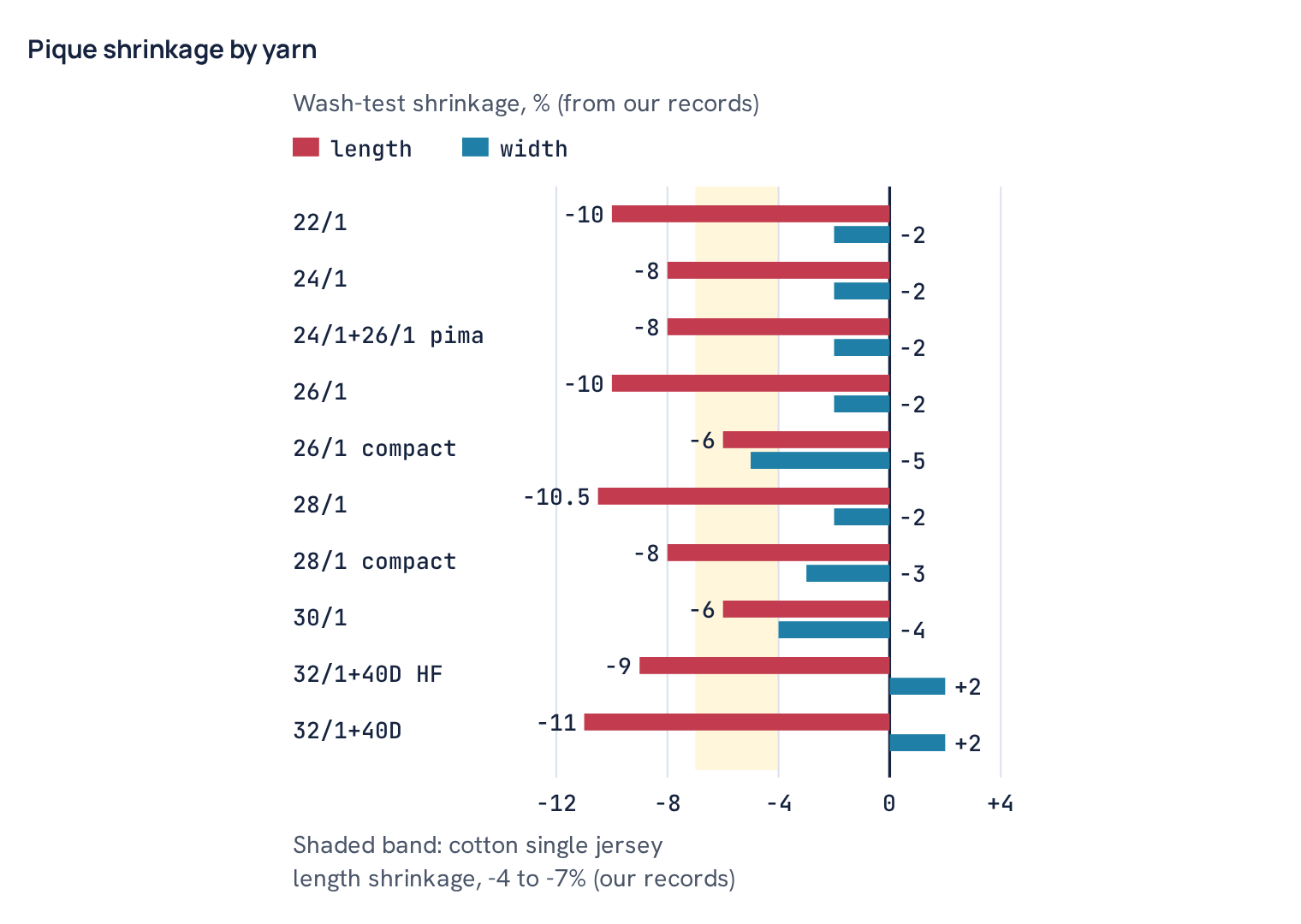
| Yarn | Required GSM | Finished GSM | GSM after wash | Shrink L, % | Shrink W, % | Spirality, % |
|---|---|---|---|---|---|---|
| 22/1 cotton | 235 | 220 (210–226) | 246 | -10 | -2 | 2 |
| 24/1 cotton | 220 | 210 (200–218) | 234 | -8 | -2 | 2 |
| 24/1 cotton + 26/1 pima | 220 | 202 (192–208) | 222 | -8 | -2 | 2 |
| 26/1 cotton | 200 | 195 (190–202) | 222 | -10 | -2 | 2 |
| 26/1 compact cotton | 190 | 182 (182–188) | 212 | -6 | -5 | 2 |
| 28/1 cotton | 200 | 172.5 (160–180) | 198 | -10.5 | -2 | 2 |
| 28/1 compact cotton | 190 | 182 (180–188) | 205 | -8 | -3 | 2 |
| 30/1 cotton | 180 | 170 (168–182) | 191 | -6 | -4 | 2 |
| 32/1 cotton + 40D elastane, half feed | 220 | 205 (198–210) | 226 | -9 | +2 | 2 |
| 32/1 cotton + 40D elastane | 215 | 206.5 (200–210) | 237 | -11 | +2 | 2 |
Reading the numbers
For most qualities the finished GSM is below the requirement, but the GSM after the wash test is at or above it: 26/1 cotton finishes at 195 against 200 and goes to 222 after washing; 24/1 finishes at 210 against 220 and goes to 234. These fabrics have enough yarn in them. They have simply not relaxed in finishing. The fix is more relaxation and compaction, not a heavier construction.
28/1 cotton is the exception that teaches the most. It is asked for at 200 GSM, finishes at a median 172.5 GSM, almost 14% light, and even after washing reaches only 198. Here the construction itself is too light for the target: at 2.55 mm on 24 gauge, 28/1 does not carry enough yarn for 200 GSM. For a 200 GSM target, a 26/1 count or a shorter stitch length is the safer choice.
Why pique finishes light and shrinks so much
- Held length. The tuck structure stores yarn in length. Wet processing under tension and stenter pinning pull it out, and the wash test lets it come back. Length shrinkage in our pique rows is -6% to -11%, against roughly -4% to -7% for cotton single jersey.
- Width stretch. Running naturally wide pique to the top of the width tolerance makes it lighter.
- Width shrinkage. Most cotton rows shrink about -2% in width; the compact and 30/1 rows shrink -3% to -5%. The Lycra pique rows show +2%, meaning the width grows after washing. The heat-set and stenter width has been set narrower than the fabric wants to sit after relaxation.
Spirality in the register is a median 2% for every main row, and in our lab reports it did not fail once, so for pique the bigger dimensional risk is length shrinkage, not twist.
Typical practice is to relax pique as much as possible before the final set: low-tension wet processing, a relax dryer where available, then generous compactor overfeed. A fibre-by-fibre view of GSM and shrinkage is in our knit GSM and shrinkage by fibre study, and the fabric shrinkage calculator helps estimate cut sizes.
How to plan greige GSM and width
- Start from the record table for the count: gauge, stitch length and the usual finished width.
- Check the finished GSM and the after-wash GSM for that quality, not only the required GSM. If after-wash is above required but finished is light, plan more compaction. If both are light, as with 28/1 for 200 GSM, change the construction.
- Knit a trial with the agreed cam chart and send it through the full bulk route, including heat set, singeing or enzyme if bulk will have them.
- Measure finished GSM, width, length shrinkage and the after-wash GSM. Adjust compaction and stenter width first, then stitch length.
- Record the greige-to-finished ratios for the next order.
Common mistake: stretching pique wide on the stenter to make the width, then shortening the stitch length to win back the lost GSM. The fabric then becomes too heavy after washing, the length shrinkage stays high, and the cells look flat.
Testing the developed fabric
We have 21 pique test reports from our lab reports. It is a small set, and reports that reached our desk include many sent because of a problem, so fail rates are higher than in production.
| Test | Typical buyer requirement (varies by buyer) | Our lab reports (pique) |
|---|---|---|
| Dimensional stability (shrinkage) | Often within ±5% L and W after the stated wash | 8 fails in 23 results; median after one wash L -1.8%, W -1.3% (13 results) |
| GSM | Often ±5% of required | 6 fails in 20 results |
| Spirality | Often 5% maximum after washing | 0 fails in 18; median 0.0%, max 2.5% |
| Skew | Set by buyer | 1 fail in 5 results |
| Bursting strength | A minimum in kPa set by the buyer | 4 fails in 16; median 175 kPa, range 104–500 kPa (9 values) |
| Pilling | Often grade 3–4 minimum | Mostly 4–5 pilling, 4 fuzzing (some at 2,000 rubs); 1 fail in 17 |
| Colour fastness to rubbing | Often dry 4, wet 2–3 or 3 | 1 fail in 18; wet grades from 2 to 4–5 |
| Colour fastness to washing, water, perspiration | Often 4 change, 3–4 staining | Washing 1 fail in 12; water 0 in 13; perspiration 2 in 12 |
| Light fastness | Set by buyer and shade | 1 fail in 9 |
| Fibre content | Within the label tolerance | 4 fails in 17 |
| pH | Often 4.5–7.5 | 0 fails in 4 |
Shrinkage is the most failed test, 8 of 23, which fits the high length shrinkage in the register. GSM fails in 6 of 20, matching the “finishes light” finding. Bursting strength fails in 4 of 16; enzyme, strong bleaching and fine yarn all reduce it. Fibre content fails in 4 of 17, which points to blend ratio or elastane content not matching the label. Spirality did not fail at all.
Wet rubbing grades range from 2 to 4–5, with three results at grade 2, so deep shades need good soaping. Testing methods and fixes:
- How to test shrinkage of knit fabric and shrinkage test fail: causes and remedies
- How to test GSM of knit fabric and GSM test fail: causes and remedies
- How to test spirality of knit fabric and spirality test fail: causes and remedies
- How to test bursting strength and bursting strength fail: causes and remedies
- How to test pilling (box and Martindale) and wet rubbing fastness fail: causes and remedies
Worked example. A buyer asks for 200 GSM cotton pique. Our records show two options. 26/1 cotton at 2.58 mm on 24 gauge finishes at a median 195 GSM, inside ±5%, and 222 after washing. 28/1 cotton at 2.55 mm finishes at 172.5 and only 198 after washing. Choose 26/1. Then, because its length shrinkage is about -10%, plan extra compactor overfeed and avoid stretching the width; re-test finished GSM, shrinkage and the after-wash GSM together.
Development record sheet and troubleshooting
Record sheet template
Use one sheet per trial, with request and actual values side by side. For pique, the cam chart and the collar details are part of the record.
| Stage | Record |
|---|---|
| Request | Buyer, style, construction name and swatch, required GSM and tolerance, width, composition, shade, collar/cuff spec, wash care, test standard |
| Yarn | Count, combed/compact, pima or other claim, supplier, lot, twist if known, elastane denier, blend ratio |
| Knitting | Machine no., diameter, gauge, feeders, cam chart (K/T per track per feeder), needle set-out, stitch length (per yarn if two yarns), input tension, elastane feed and draft, take-down, speed |
| Greige | Greige GSM, tubular dia, roll weight, faults (wrong cam lines, barre, holes) |
| Heat set / singe | Temperature, time or speed, set width, overfeed; singeing yes/no and speed |
| Wet process | Pretreatment, enzyme yes/no, dye recipe, fixation conditions, disperse step for blends, wash-off, softener |
| Stenter | Temperature, speed, set width, overfeed, weft straightening |
| Compactor | Overfeed, steam, temperature, exit width |
| Collar and cuff | Yarn and lot, structure, size, tipping colours, dyed with body yes/no, shade and shrinkage vs body |
| Finished | GSM, width, GSM after wash, shrinkage L/W, spirality and skew, shade result |
| Lab tests and decision | Each result against requirement; approved or what changes next, and why |
Troubleshooting
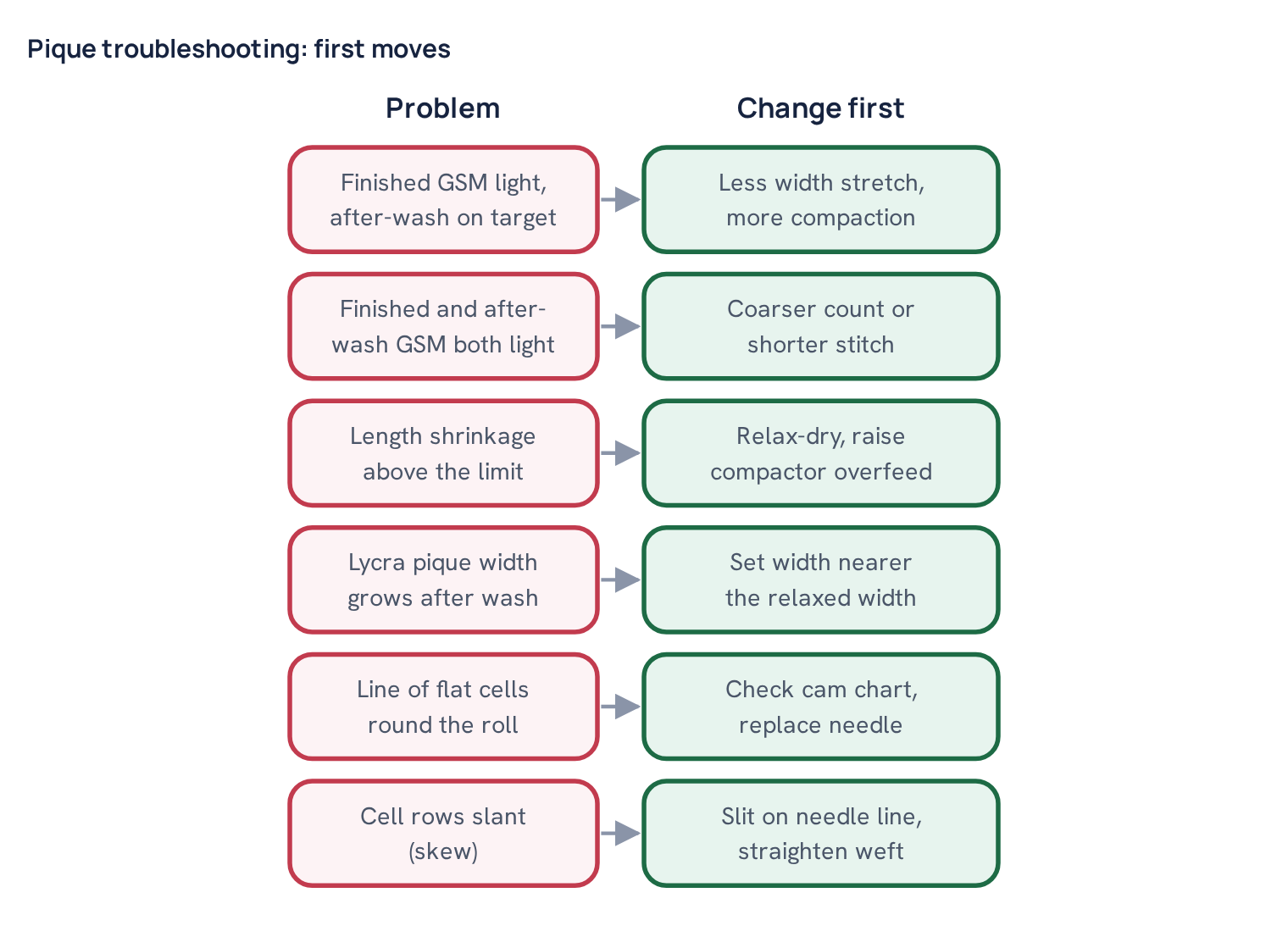
The decision chart below covers the most common pique problems; the table adds the rest. Change one thing at a time.
| Problem | Likely cause | What to change |
|---|---|---|
| Finished GSM low, after-wash GSM on target | Length stretched in; stenter too wide; too little compaction | More compactor and stenter overfeed, less width stretch |
| Finished and after-wash GSM both low | Construction too light (e.g. 28/1 for 200 GSM) | Coarser count or slightly shorter stitch length |
| Length shrinkage high | Tension in wet process; low compaction | Relax-dry, raise compactor overfeed, lower fabric tension |
| Lycra pique grows in width after wash | Set width narrower than the relaxed width | Heat set and stenter nearer the relaxed width |
| Cells flat or unclear | Loose stitch length, over-stretched width, crushed in compactor, heavy softener | Tighter stitch, less width stretch, moderate compaction, lighter softener |
| Line of flat cells round the roll | A cam set to knit instead of tuck, or a faulty needle | Check cam chart on every feeder; replace needle |
| Cell rows slant (skew) | Fabric fed crooked at slitting or stenter; many feeders | Slit on needle line, use weft straightener, feed square |
| Collar shade off body | Different yarn lot or dye batch; structure looks different | Same yarn lot, dye with body, judge as a garment |
| Tipping bleeds into collar ground | Poorly fixed or poorly washed yarn-dyed tipping | Better washed tipping yarn; test staining before knitting |
| Bursting strength low | Heavy enzyme, strong bleach, fine yarn | Reduce enzyme dose or time; check bleach; consider coarser count |
| Pilling or fuzz | Hairy yarn, no enzyme or singeing | Compact or combed yarn; enzyme; singe if specified |
| Fibre content fail | Blend ratio or elastane % not as labelled | Check yarn certificate; calculate elastane from feed |
For patchy or lot-to-lot shade problems, which show strongly on a plain-shade polo, see uneven and patchy dyeing and lot-to-lot shade variation.
Pique rewards an engineer who respects the cam chart and the compactor. Agree the construction by its K/T repeat, choose a count whose after-wash GSM reaches the target, plan for the high length shrinkage, and keep the collar and cuff in the same development loop as the body.
Questions
What is the difference between single and double Lacoste?
Both are tuck-stitch single jerseys on alternate needles. Single Lacoste repeats over 4 feeders (knit-tuck, knit-knit, tuck-knit, knit-knit); double Lacoste repeats over 6, with two tucks in a row on each needle track, giving deeper cells. Names vary between mills, so always agree the cam chart.
Why is pique wider and heavier than single jersey?
Tuck loops are not pulled through another loop, so they open out and push the wales apart, and held loops draw the courses together. In our records 24/1 cotton pique is asked for at 220 GSM and finishes about 190 cm wide, against 180 GSM and 176 cm for 24/1 single jersey.
What stitch length is used for cotton pique?
In our records cotton pique on 24 gauge runs at a median 2.50 to 2.70 mm: for example 2.60 mm for 24/1 at 220 GSM and 2.58 mm for 26/1 at 200 GSM. Use these as starting points and confirm with a trial.
Why does pique shrink so much in length?
The tuck structure stores length that wet processing and the stenter pull out, and washing lets it return. In our records pique length shrinkage in the wash test is -6% to -11%, so generous relaxation and compactor overfeed are essential.
How do you match a flat-knit collar to the pique body?
Use the same yarn source and lot, dye the collars with the body in the same batch where possible, and judge the pair under the buyer’s light source as a garment. Also check that collar and body shrink alike and that tipping yarn does not bleed.

Textile engineer with 14+ years in dyeing and fabric development. He writes every guide on Dyeing Solution from real production work. Full profile