A step-by-step development guide for the design rib family: needle set-outs, loop transfer and needle selection, low-tension dyeing, heat setting, keeping the pattern open, hitting GSM and width, and testing, built on our real development records.
At a glance
467design rib entries in our register
-4.6%median finished vs required GSM
+13.8%median GSM rise after the wash test
8 of 14GSM lab results that failed
Design rib is where plain rib becomes a design: a pointelle rib with small eyelets, a drop-needle rib with flat channels, a jacquard rib with a raised or two-colour motif. All start from the same double-jersey rib machine, and all need more care than plain rib. The pattern must be knitted correctly, survive a jet dyeing machine without bursting or closing up, and come out of the stenter and compactor at the right GSM and width with the design still open. This guide follows the route from yarn to tested fabric for the whole family, with and without elastane, built on our fabric register: 467 design rib, pointelle, drop-needle and jacquard rib entries, plus 14 lab reports. Values from general practice are marked as typical.
What design rib is
A rib base with a pattern on top
Every fabric in this family is knitted on a circular double-jersey machine with two sets of needles: cylinder needles standing vertically and dial needles lying horizontally on top. In plain 1×1 rib every needle on both beds knits every course, so face wales and back wales alternate across the width. A design rib changes that simple rule in one of three ways:
- Take needles out of work. Some needles are removed or put out of action in a set order. Where a needle is missing there is no wale, and the fabric shows a channel or a flat stripe. This is drop-needle rib.
- Move loops. At chosen places a needle hands its loop to a neighbouring needle on the other bed. The emptied needle then starts a new loop with nothing to hold it, and an eyelet opens. This is pointelle rib.
- Select needles. A pattern device decides, needle by needle and feeder by feeder, whether each needle knits, tucks or misses. The result is a raised texture or a coloured motif. This is jacquard rib, and most other “design rib” qualities are simpler forms of the same idea.
The rib fabric development guide explains the dial and cylinder, the basic set-outs and why rib finishes narrow; all of it still applies here.
The members of the family in our register
Our register records eight design rib types, which fall into four groups:
- Pointelle rib, plain or with elastane: eyelets in lines, diamonds or small motifs, for babywear, nightwear and summer tops.
- Drop-needle rib, in our register always an elastane quality: flat channels between groups of rib wales, for fitted tops and loungewear.
- Jacquard rib: a raised texture, or a two-colour motif when coloured yarns are used.
- Other design ribs, including yarn-dyed design rib: short tuck or miss repeats, ply yarns, and cotton with polyester filament.
By fibre family the register has 191 CVC/PC entries, 160 cotton, 71 cotton with elastane, 27 CVC/PC with elastane, 13 other fibres with elastane and 5 other fibres, so about a quarter of design rib contains elastane.
Properties you must design around
- Holes and thin places. Eyelets, channels and floats are weak points by design. Under tension they open, stretch or split, and bursting strength is lower than for a plain rib of the same weight.
- Width that moves. Missing needles and transferred loops leave fewer wales and longer sinker loops, so the width is even less stable than in plain rib.
- Floats that snag in machine parts and in wear.
- A pattern that must stay open. Heavy compaction closes eyelets; heavy width stretch distorts them and makes the fabric light.
- Low spirality. Design rib is a balanced double-jersey structure; in our register the median spirality is 2 to 3%.
How each design is made
Drop-needle rib: a needle set-out with out-of-action needles
Start from a 1×1 rib set-out and take a cylinder needle out of work every few needles, or put it out of action so it never rises to take yarn. At that position no face wale forms; the yarn runs from one dial needle to the next as a longer sinker loop. On the face this shows as a vertical channel where the back wales come forward. One missing needle every six, eight or twelve gives evenly spaced channels; several together give a wider flat stripe.
The set-out is the whole design, so write it down exactly: which bed, which positions, how many needles in the repeat, with a filled dot for a working needle and an open dot for an empty slot.
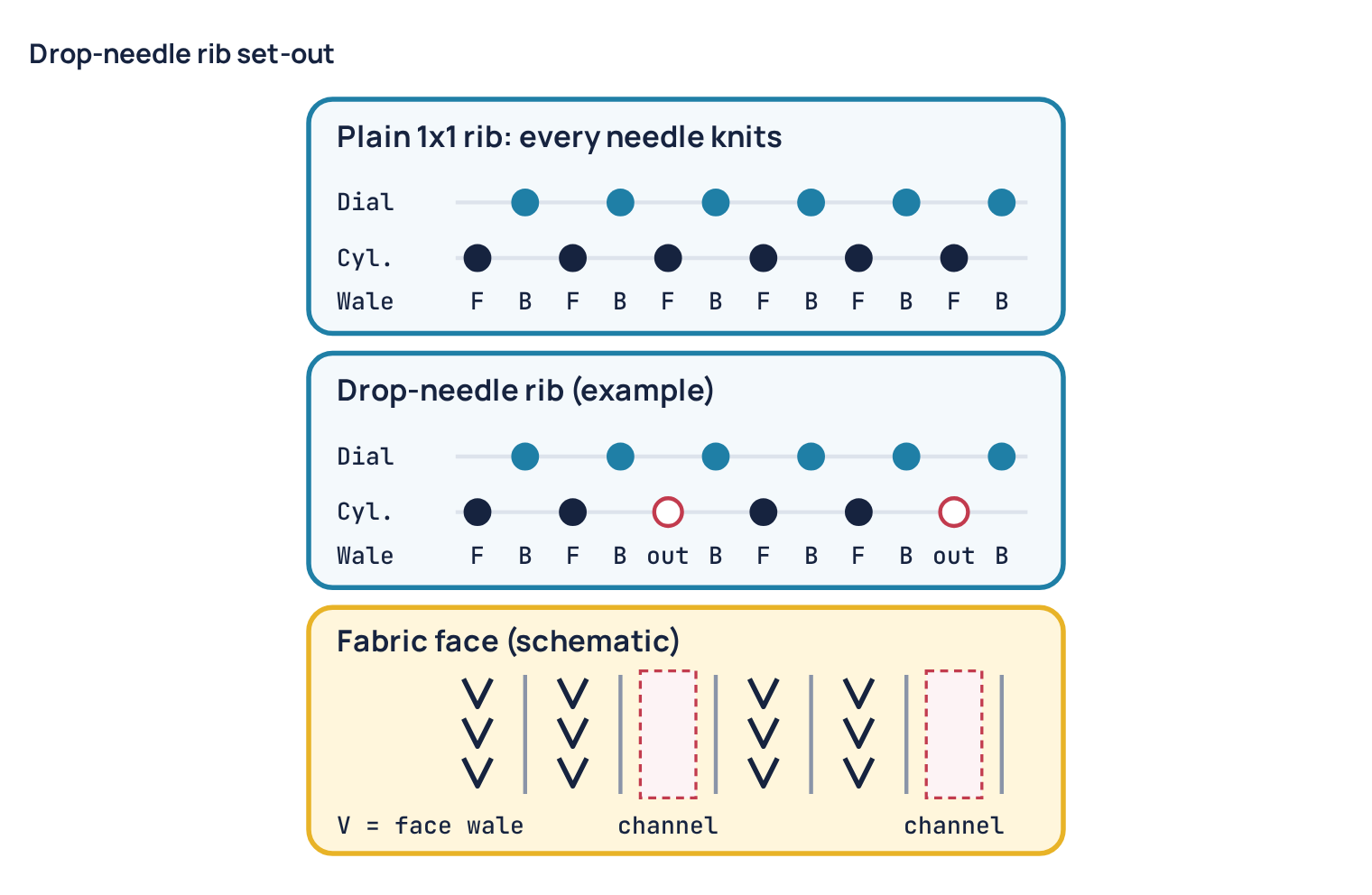
Taking needles out makes the fabric narrower for the same machine, and the longer sinker loops at each channel can borrow yarn from neighbouring loops, so channels open or close with the way the fabric is held. Elastane, once heat-set, holds the structure.
Pointelle rib: loop transfer for eyelets
A pointelle eyelet is made by moving a loop. On a circular pointelle machine, selected needles carry a transfer element, typically a spring on the needle stem, and some feeders have transfer cams. There, a selected needle rises with its loop on the transfer element, the needle on the opposite bed enters that loop, and the first needle withdraws, leaving both loops on the second needle.
At the next feeder the emptied needle forms a new loop, but there is no old loop to pull it through, so an open space, the eyelet, is left below it. The neighbour knits its two loops off together, closing the edge neatly. A chart of transfer points gives lines, diamonds or small flowers.
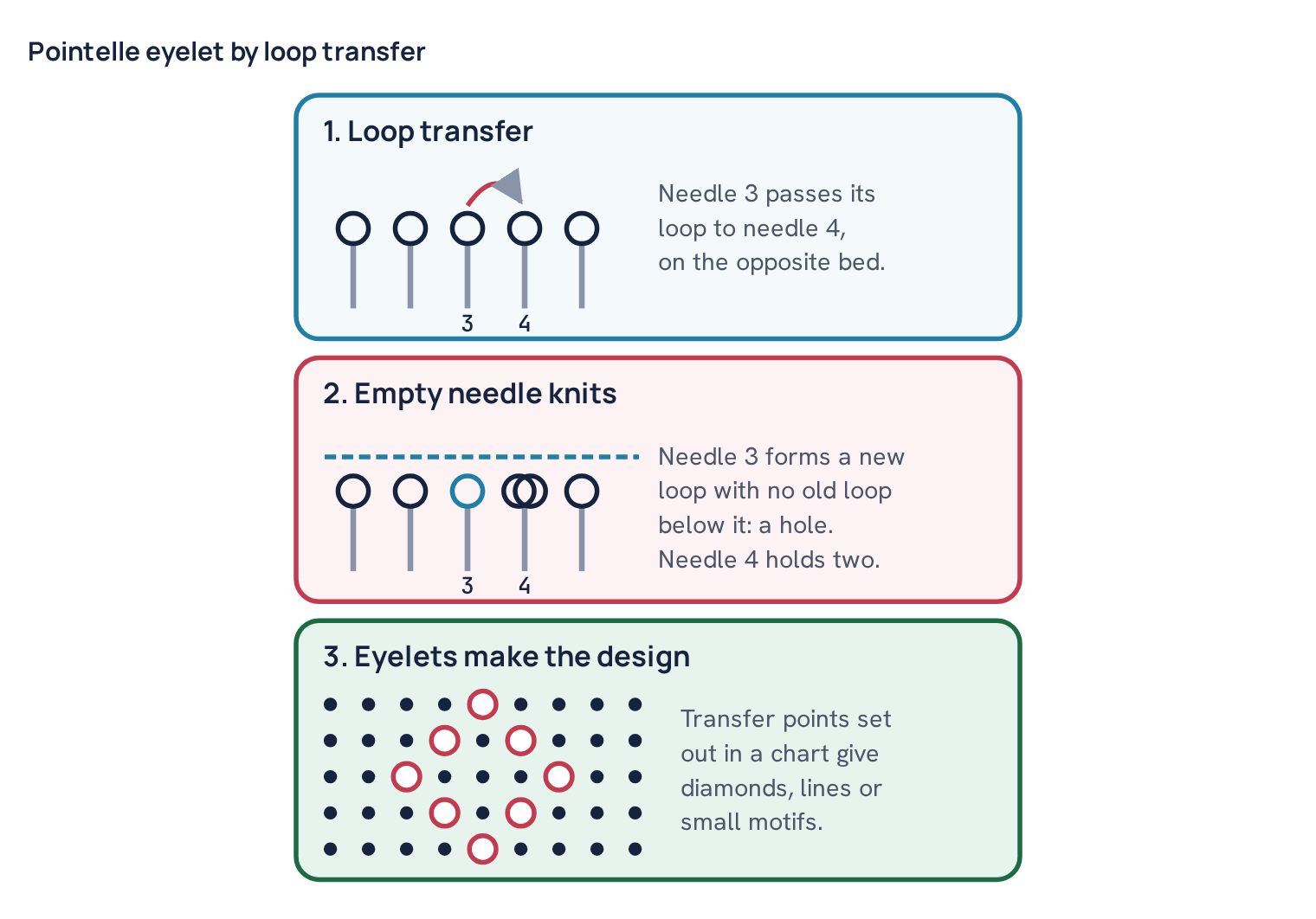
A longer stitch length and a finer yarn give bigger eyelets; compaction and relaxation pull them smaller. Judge the approved sample at its finished width, and plan finishing with the pattern in mind, not only the GSM.
Common mistake: treating the eyelets as faults during greige inspection, or, the opposite, letting real holes pass because “the fabric has holes anyway”. Mark the design repeat on the inspection card so inspectors know exactly where a hole belongs.
Jacquard rib: needle selection
In jacquard rib the pattern comes from selection. At each feeder, each needle can be made to do one of three things:
- Knit. The needle rises fully, takes the new yarn and casts off the old loop. A normal loop is formed.
- Tuck. The needle rises only part way. It takes the new yarn but keeps the old loop. The held yarn adds bulk and makes the fabric wider and thicker.
- Miss. The needle stays down. The yarn floats past it on the back. Misses make the fabric narrower and form floats.
Older machines select with pattern wheels, drums or butt arrangements, which limits the repeat size; electronic machines select every needle at every feeder from a stored chart. With two coloured yarns, each colour knits only where the chart wants it, and the back shows the hidden colour in a birdseye arrangement. This is how yarn-dyed design rib gets its motif.
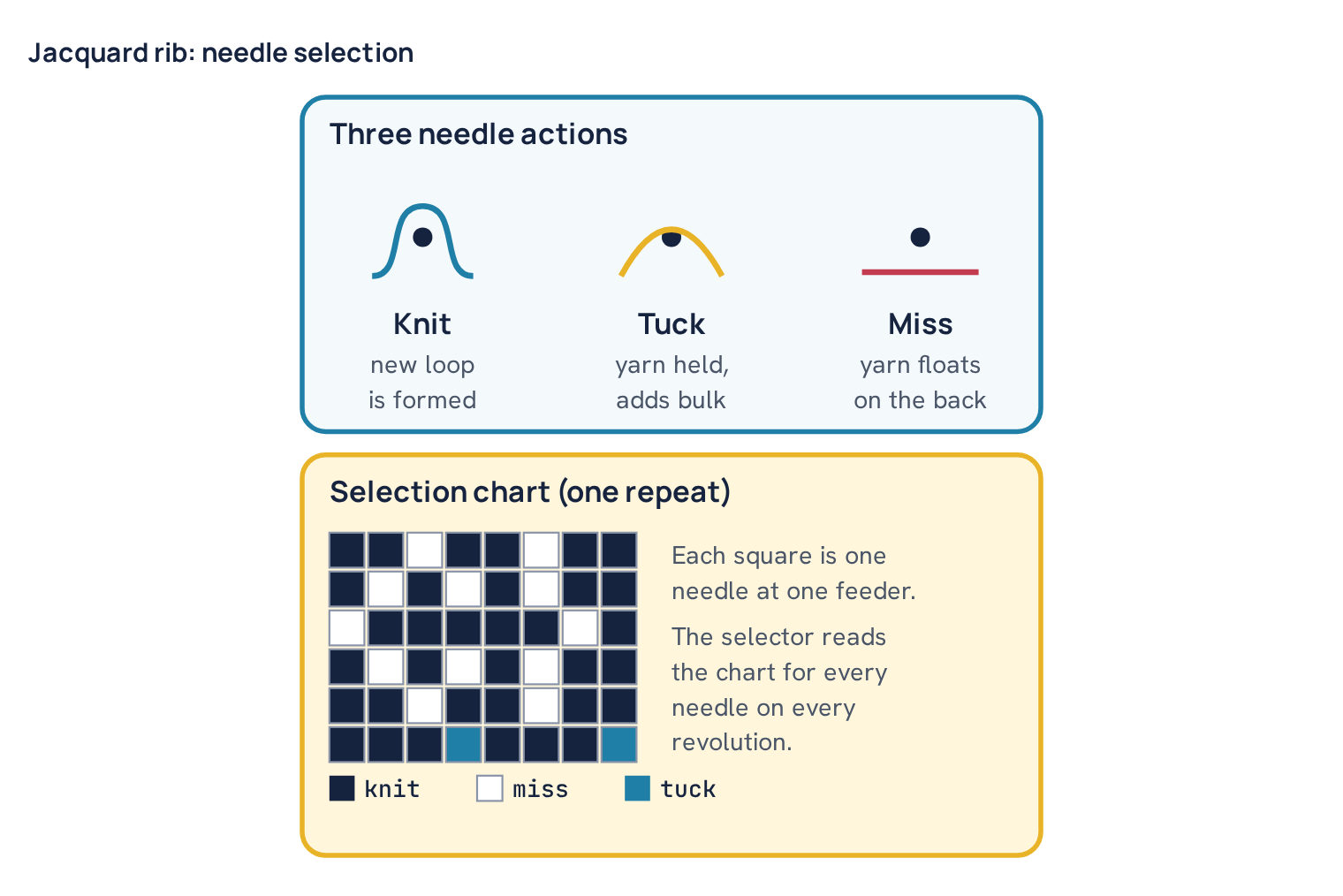
Many misses make a jacquard rib narrower and heavier than its ground suggests; many tucks make it wider and thicker. Break floats longer than a few needles with a tuck or knit where the design allows.
Other design ribs
Many qualities simply called “design rib” are rib grounds with a short tuck or miss repeat, or two yarns of different type, such as cotton with a cotton ply or with polyester filament for texture or a two-tone effect. The rules are the same: record the set-out, the selection chart and the stitch length per yarn.
New to pointelle? Our short guide what is pointelle fabric explains the pointelle stitch, its types and its care in plain words. This guide goes on to the development details.
Development inputs
Read the buyer’s request, and get the design
Collect the usual requirements in one place: finished GSM with tolerance, finished width, composition, shade and light source, wash care and test requirements. For design rib add three more:
- The pattern itself. A physical approved sample, or artwork with the repeat size in wales and courses. A photograph is not enough to knit from.
- The look of the eyelets or channels. Open or closed, crisp or soft. Agree it on a finished sample, not on greige.
- Bursting strength and snagging requirements. Pointelle and float-heavy designs are at risk here, so ask which bursting minimum applies before you choose the yarn.
Choosing the yarn
Count. Our design rib entries run from 24/1 to 34/1 single cotton, plus ply and filament combinations. Coarser counts give heavier, stronger fabric; finer counts give clearer eyelets but less strength around them.
Quality and spinning. Combed or compact yarn gives cleaner pattern edges and better pilling. Air-jet spun CVC, which appears in our register, has low hairiness but a firmer hand. A ply yarn adds strength and gives a rounder loop.
Elastane. Usually 20 to 40 denier bare elastane, plated with the ground yarn. It holds a drop-needle or pointelle structure together, and it means heat setting and a narrower width.
Yarn-dyed qualities. Check the yarn dyer’s fastness reports before knitting. A yarn-dyed design rib cannot be corrected later in the dye house.
Common mistake: moving to a finer count to make eyelets more open without checking bursting. The pattern looks better, and the fabric fails the bursting test.
Knitting
Gauge and machine diameter
Design rib in our register is almost all 18 gauge: 413 of 467 entries, with a few at 16, 14, 24 and 20 gauge. The most used diameter is 34 inch (226 entries), followed by 36 inch (75), 40 inch (67), 38 inch (43) and 44 inch (26). As with plain rib, the machine diameter is large compared with the finished width, because rib closes in width when it relaxes, and missing needles reduce the working needle count further.
Worked example. A 34 inch, 18 gauge rib machine has 34 × 3.1416 × 18 = about 1,923 needles on each bed. In plain 1×1 rib all of them knit. If one cylinder needle in every six is taken out for a drop-needle design, about 320 cylinder needles are out of work, so about 1,603 cylinder needles still knit. Fewer face wales means a narrower fabric for the same finishing, unless the channels are held open in the stenter.
Stitch length, count and GSM
The basic relation is GSM = courses per cm × wales per cm × stitch length (mm) × yarn tex ÷ 100, with tex = 590.5 ÷ Ne, counting both beds’ loops. Try combinations with the knit GSM from stitch length calculator or the GSM calculator. For design rib this is only a first guess, because missing needles, tucks and transfers change the loop count; start from a recorded construction and adjust after a trial.
Yarn, stitch length and GSM from our records
The table shows the six design rib yarns with the most entries in our register. Stitch length is the median in mm with the interquartile range in brackets. Where a quality is knitted with two yarns, the stitch length per yarn is shown as recorded, in yarn order. Finished dia is the open width after finishing; shrinkage is the dye-house wash test.
| Yarn | Gauge | Entries | Stitch length, mm | Required GSM | Finished GSM | GSM after wash | Finished dia, cm | Shrink L / W, % | Spirality, % |
|---|---|---|---|---|---|---|---|---|---|
| 24/1 cotton | 18G | 15 | 3.15 (3.15–3.55) | 235 | 194 (175–320) | 260 | 185 | -7 / -3 | 2 |
| 26/1 cotton | 18G | 15 | 3.20 (3.10–3.25); two-yarn entries 2.50 + 2.70 (n=4) | 230 | 190 (175–260) | 222 | 180 | -7 / -3 | 2 |
| 34/1 cotton + 30 denier elastane, full feeder | 18G | 13 | 3.10 (3.10–3.25) | 220 | 193 (188–202) | 232 | 165 | -5 / -3 | 3 |
| 32/1 cotton + 32/2 ply cotton | 18G | 12 | 3.30 + 2.50 (n=11) | 260 | 254.5 (250–258) | 285 | 181.5 | -6 / -2.5 | 2 |
| 30/1 cotton | 18G | 11 | 3.00 + 2.40 (n=9) | 260 | 232 (205–253) | 272 | 148 | -6 / -4 | 2 |
| 26/1 CVC 60/40, air-jet spun | 18G | 11 | 3.10; two-yarn entries 2.65 + 2.25 (n=5) | 200 | 180 (170–205) | 202 | 205 | -3 / -2 | 2 |
Four points stand out. First, each row has only 11 to 15 entries, because design rib is spread over many patterns; treat each row as a starting construction, not a standard. Second, single-yarn qualities run at about 3.10 to 3.20 mm on 18 gauge, a fairly open loop that helps transfers and missed needles knit cleanly. Third, the finished GSM range for 24/1 cotton, 175 to 320, shows how much the design itself changes the weight. Fourth, the CVC quality finishes widest, 205 cm, and shrinks least, -3% L and -2% W, against -5% to -7% length shrinkage for cotton.
Two-yarn entries show the stitch length per yarn as recorded, in yarn order, for example 3.30 + 2.50 mm for 32/1 cotton with 32/2 ply cotton. Record your own trials the same way.
Elastane in design rib
Elastane in design rib is fed under controlled draft from positive feeders, plated behind the ground yarn as in Lycra rib. In our register, 111 of the 467 entries contain elastane, and the most common elastane quality is 34/1 cotton with 30 denier on full feed. Points to watch:
- Feed it where the design needs it. Full feed gives even power across the pattern. Partial feed can leave some courses without elastane, which shows as rippled bands in a drop-needle or pointelle design.
- Equal tension. Uneven draft between feeders shows as bars or as eyelets of different size in different courses.
- Expect more closing. Elastane pulls eyelets and channels together; a Lycra pointelle may need a slightly longer stitch length or a wider heat-set width to match the approved eyelet size.
For elastane plating in general see the Lycra single jersey development guide.
Machine settings to record
Record everything a plain rib trial needs (machine, gauge, feeders, yarn lots, measured stitch length per yarn, input tension, elastane draft, take-down, greige GSM and dia), plus the needle set-out for both beds, the selection or transfer chart with its repeat, and which feeders knit, tuck, miss or transfer. The full list is in the record sheet at the end of this guide.
Greige inspection
Inspect against the design card: the repeat correct across the full width, no missing or extra transfers, no dropped stitches next to eyelets, where a loop easily runs into a ladder, and no pulled floats. Measure greige GSM and dia after the roll has rested.
Why design rib is delicate in dyeing
In a jet or soft-flow machine the fabric travels as a rope, pulled through a nozzle by liquor and a winch, many hundreds of times per cycle. Plain rib takes this well. Design rib has built-in weak points, and the rope process finds them:
- Holes stretch and split. Loops round an eyelet carry more load than normal loops, and repeated rope tension can split one, turning a design hole into a real hole.
- Bursting strength drops. Peroxide bleaching, strong enzyme and long hot runs all cost strength, and an open pointelle has little in reserve. In our lab reports bursting on design rib had a median of 194 kPa, ranging from 75 to 500 kPa, with 2 fails in 13 results.
- Floats snag and pull. Floats on the back catch on the nozzle, on the winch and on other fabric, and leave pulled loops in the face.
- Width and pattern distort. The rope stretches the fabric in length and narrows it. Channels and eyelets are pulled long and thin; if they are set in that shape by heat or by drying, they stay that way.
- Crease marks. A heavy jacquard or elastane design rib folds hard in the rope and can mark. See crease marks in knit dyeing.
Spirality is not a big worry: 2 to 3% in the register wash test, and in our lab reports a median of 0.0% and a maximum of 4.0% after washing, with no fails in 24 results. Width is the bigger issue: wash-test width shrinkage is -2% to -4%.
Dyeing and finishing route
All 467 design rib entries in our register are finished open width on stenter and compactor. The route is the rib route with lower tension at every step. Parameters are typical and vary with dyes, chemicals and machines. Short overviews are in the pointelle, drop-needle rib, jacquard knit and rib dyeing and finishing flowcharts; the wet processes are in 100% cotton knit dyeing process, cotton elastane (Lycra) knit dyeing process and CVC fabric dyeing process.
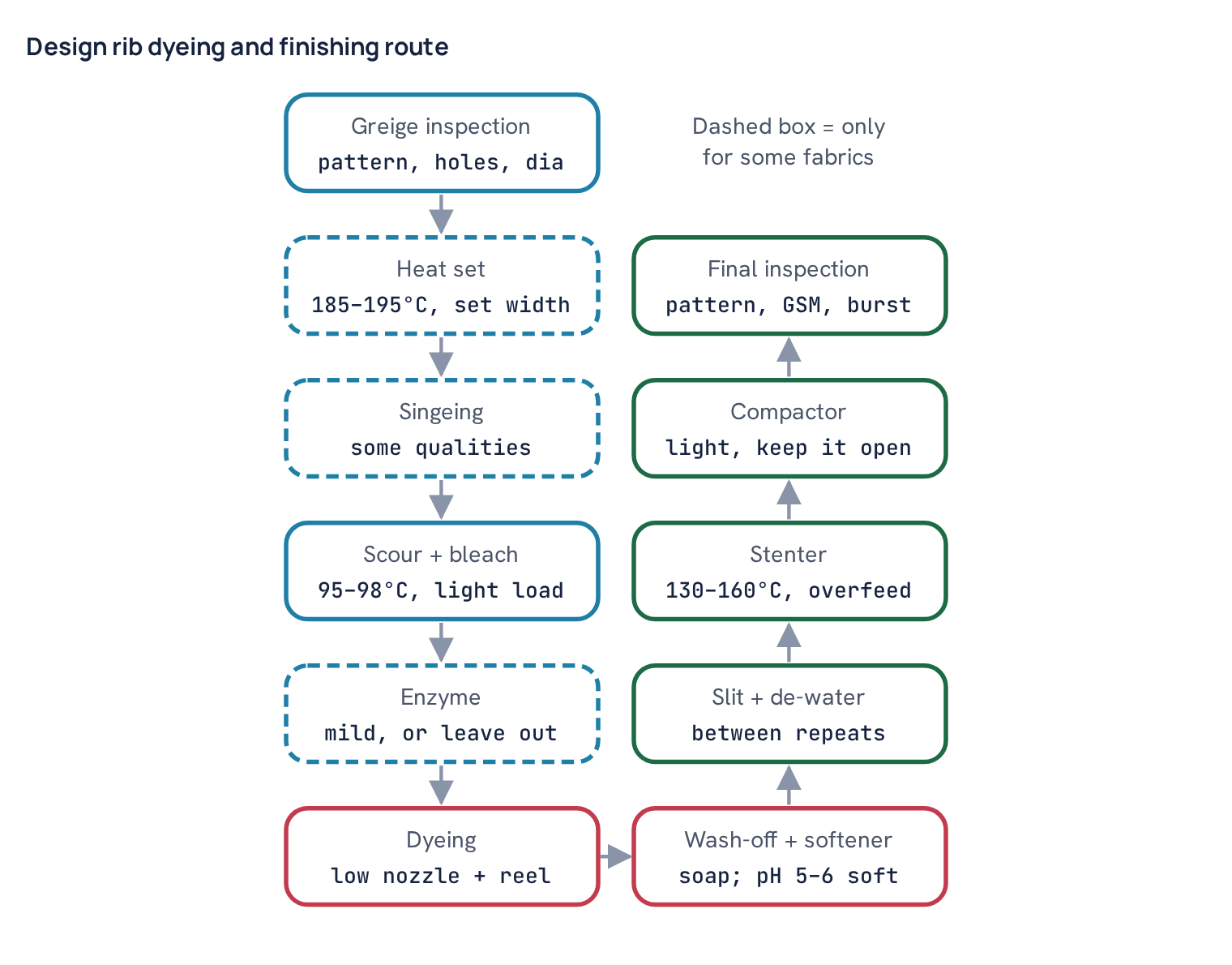
Heat setting elastane design rib
Of the 457 design rib entries with this field filled in, 49% carry a heat-set flag: 211 heat set only, 10 heat set with singeing and 2 heat set with singeing on both sides. That is about twice the share of entries with elastane, because qualities with polyester, such as CVC/PC and cotton with polyester filament, are also often heat-set to fix their width before wet processing.
- Temperature and time. Typically 185 to 195°C for 30 to 60 seconds on the stenter for cotton with elastane. Lower settings are used when the fabric is sensitive to yellowing or when the polyester content does not need more.
- Width. Set at the width that gives the right pattern opening and finished GSM. Heat setting fixes the pattern in whatever shape it has, open or closed, so this is the key decision for elastane design rib.
- Overfeed. Give enough overfeed so the length is not stretched; a design set long and narrow stays long and narrow.
- Straight feeding. Feed the fabric straight on the pins. A pattern set skewed or bowed cannot be corrected later.
Singeing appears on 62 entries (50 singeing only, 12 combined with heat setting). It burns off surface fibres for crisper pattern edges and better pilling; run it gently on pointelle, where a thin design can be scorched.
Pretreatment and dyeing at low tension
- Load lighter. A load of about 70 to 80% of the rated capacity for open designs is typical practice, so the fabric is not packed in the chamber.
- Lower nozzle pressure and reel speed. Use the lowest settings that keep the rope moving without tangling.
- Lubricant in every bath, to protect floats and eyelets.
- Scour and bleach typically at 95 to 98°C for 45 to 60 minutes with caustic soda, hydrogen peroxide, stabiliser and wetting agent. Do not overdose peroxide; an open fabric loses strength faster than it gains whiteness.
- Enzyme with care. Acid cellulase at about pH 4.5 to 5.5 and 50 to 60°C improves surface and pilling, but it also weakens the yarn. On a low-bursting pointelle, use a mild dose and short time, or leave it out.
- Reactive dyeing with salt and alkali dosed in steps, fixation typically at 60°C for most vinyl sulphone and bifunctional dyes and up to 80°C for hotter types, at about pH 10.5 to 11. CVC/PC adds a disperse step for the polyester, typically at 130°C. See how reactive dyes work; for uneven results see uneven and patchy dyeing and level dyeing and uneven shades.
- Wash-off and softener. Soap near the boil, then softener at about pH 5 to 6 and 30 to 40°C; a smooth softener also reduces snagging in finishing.
Low-tension finishing and keeping the pattern open
Every machine after dyeing stretches or compresses the fabric, and the pattern follows.
- Slitting and de-watering. Slit on a marked line that falls between repeats, not through a line of eyelets. Squeeze with low pressure; a heavy squeeze flattens texture.
- Stenter. Typically 130 to 160°C for cotton, below the heat-set temperature for elastane qualities, with overfeed and the width close to the planned finished width. A small width pull opens eyelets; a large one makes ovals, light GSM and width shrinkage.
- Compactor. Only the steam and overfeed needed for length shrinkage; heavy compaction closes eyelets and flattens channels.
- Tensionless drying, if available. A relax dryer before the stenter lets the fabric shrink freely, which helps both shrinkage and pattern shape.
Worked example. A pointelle rib reaches the right GSM, but the buyer rejects it because the eyelets look closed. Before changing the knitting, run a piece through the stenter 3 to 4 cm wider with the same overfeed, then compact with less overfeed. If the eyelets open and GSM stays in tolerance, change the finishing plan; if GSM drops out, change the stitch length or yarn instead.
Hitting finished GSM and width
What our records show
Design rib, like plain rib and single jersey, tends to finish light. Across 446 entries with both values, the median finished GSM is 4.6% below the required GSM. 42% finish within ±5% of the requirement, 46% finish more than 5% light and 11% finish more than 5% heavy. After the dye-house wash test the GSM rises a median 13.8% across 451 entries. That rise is large: the fabric leaves finishing more open than it wants to be, and the wash closes it.
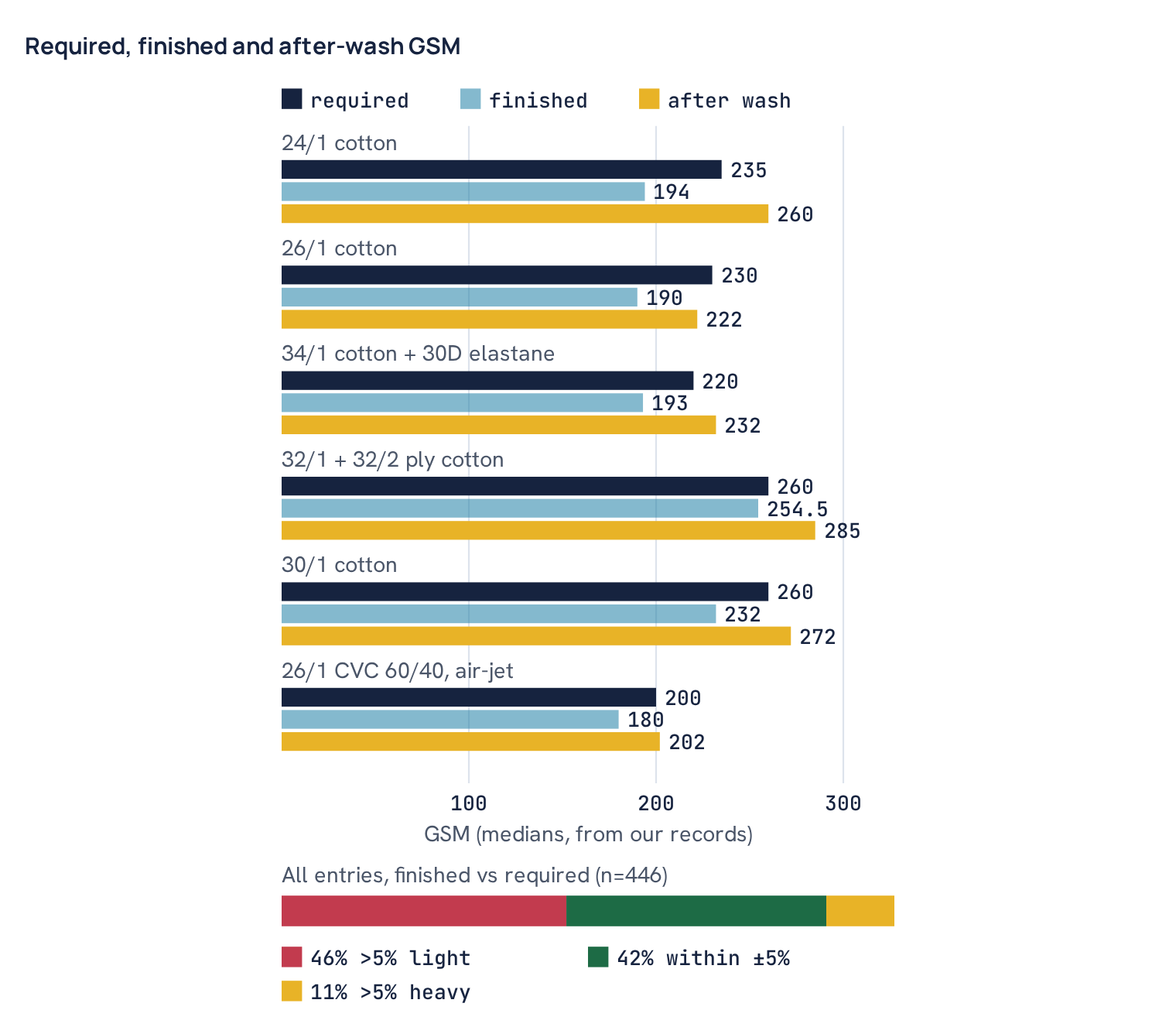
In five of the six main yarns the after-wash GSM is at or above required while finished GSM is below it; only 26/1 cotton stays below required even after washing (222 against 230). Each row mixes designs, so use the rows for direction and the overall figures for planning.
Why design rib finishes light
- Width held open to show the pattern. Wider means lighter.
- Length not fully relaxed. Because heavy compaction closes the design, compactor overfeed is often kept low, and some length stays stretched in.
- Elastane recovery. In elastane qualities the elastane keeps pulling, so the wash closes the fabric more.
- Pattern effect. Tucks, misses and transfers change the loop count, so first trials are often off target.
Width and shrinkage
Finished dia for the main yarns runs from 148 cm (30/1 cotton) to 205 cm (26/1 CVC). Wash-test length shrinkage is -5% to -7% for cotton and -3% for CVC; width shrinkage is -2% to -4%, which is the width coming back on a fabric held open in finishing. Estimate the effect on a cut panel with the fabric shrinkage calculator; a fibre comparison is in our knit GSM and shrinkage by fibre study.
How to plan greige GSM and dia
- Start from the record table: yarn, 18 gauge, stitch length per yarn and the usual finished dia for the nearest quality.
- Agree the pattern look and the width first. In design rib width, GSM and pattern opening are one decision.
- Knit a short trial with the exact set-out and selection chart, and record greige GSM and dia.
- Run the trial through the full bulk route, including heat setting at the planned width. A lab shortcut does not show how the pattern behaves.
- Measure finished GSM, dia, after-wash GSM, shrinkage and bursting, and compare the pattern with the approved sample. If finished GSM is low but after-wash GSM is right, relax more and stretch less. If both are low, shorten the stitch length slightly or move to a heavier yarn.
- Write the greige-to-finished ratios on the record sheet.
Common mistake: fixing a light design rib only by opening the stenter less. The GSM comes up, but the eyelets close and the buyer rejects the look. Agree a balance between width, GSM and pattern on one finished sample.
Testing the developed fabric
Only 14 design rib lab reports reached our desk, and many were sent because of a problem, so their fail rates are higher than in overall production. They are too few to give a production average, but they show clearly where the risk lies.
| Test | Typical buyer requirement (varies by buyer) | Our lab reports (design rib) |
|---|---|---|
| Dimensional stability (shrinkage) | Often within ±5% L and W after the stated wash | 10 fails in 25 results; median after one wash L -1.4%, W -1.0% (n=12) |
| GSM | Often ±5% of the required GSM | 8 fails in 14 results |
| Spirality | Often 5% maximum after washing | 0 fails in 24 results; median 0.0%, max 4.0% |
| Bursting strength | A minimum in kPa set by the buyer | 2 fails in 13 results; median 194 kPa, range 75–500 kPa (n=11) |
| Pilling | Often grade 3–4 minimum | 0 fails in 13; mostly 4–5 pilling, 4 fuzzing; one Martindale result 3–4 at 2,000 rubs |
| Colour fastness to rubbing | Often dry 4, wet 2–3 or 3 | 2 fails in 12; wet grades seen: 3 (4 times), 2–3 (4), 4 (2), 4–5 (2) |
| Colour fastness to washing | Often 4 change, 3–4 staining | 1 fail in 11 |
| Colour fastness to perspiration | Often 4 change, 3–4 staining | 1 fail in 12 |
| Colour fastness to water | Often 4 change, 3–4 staining | 2 fails in 10 |
| Fibre analysis | Within the label tolerance | 2 fails in 11 |
| Light fastness | Set by buyer and end use | 0 fails in 2 |
GSM failed in 8 of 14 results, matching the register’s picture of a fabric that finishes light. Shrinkage failed in 10 of 25, though the median after one wash was only -1.4% L and -1.0% W; the fails come from lots held too wide or too long. Bursting failed only twice in 13, but the range is wide, and the low end belongs to open, light designs, so check it on every new pointelle or drop-needle construction.
Pilling and spirality did not fail. Fibre analysis failed twice, a reminder to declare elastane and filament content correctly. Wet rubbing at 3 and 2–3 is common on medium and dark shades. For shade problems on mixed yarns see shade variation lot to lot.
- How to test bursting strength of knit fabric and bursting strength fail: causes and remedies
- How to test shrinkage of knit fabric and shrinkage test fail: causes and remedies
- How to test GSM of knit fabric and GSM test fail: causes and remedies
- How to test spirality of knit fabric and spirality test fail: causes and remedies
- Pilling test by box and Martindale and wet rubbing fastness fail: causes and remedies
Development record sheet and troubleshooting
Record every setting and change one thing per trial, so the pattern can be repeated in bulk.
Record sheet template
| Stage | Record |
|---|---|
| Request | Buyer, style, required GSM and tolerance, finished width, composition, shade, wash care, test standard, bursting minimum |
| Design | Design type (pointelle, drop-needle, jacquard, other), approved sample reference, repeat size in wales and courses, eyelet or channel look agreed |
| Yarn | Count, type, spinning, supplier, lot for each yarn; elastane denier; yarn-dyed fastness report |
| Knitting | Machine no., diameter, gauge, feeders; needle set-out for both beds; selection or transfer chart; stitch length per yarn (measured); input tension; elastane draft and feed; take-down; speed |
| Greige | Greige GSM, tubular dia, roll weight, pattern check, faults |
| Heat set / singeing | Temperature, time or speed, set width, overfeed; singeing yes/no and side |
| Wet process | Machine, load %, nozzle pressure, reel speed, lubricant, pretreatment, enzyme dose, dye recipe, fixation temperature and pH, wash-off, softener |
| Stenter | Temperature, speed, set width, overfeed |
| Compactor | Overfeed, steam, exit width, pattern check |
| Finished | Finished GSM, open width, GSM after wash test, shrinkage L/W, spirality, pattern vs approved sample |
| Lab tests | Each result against requirement, especially bursting, GSM and shrinkage |
| Decision | Approved / adjust; what will change in the next trial, and why |
Troubleshooting
The diagram gives the first move; the table adds likely causes.
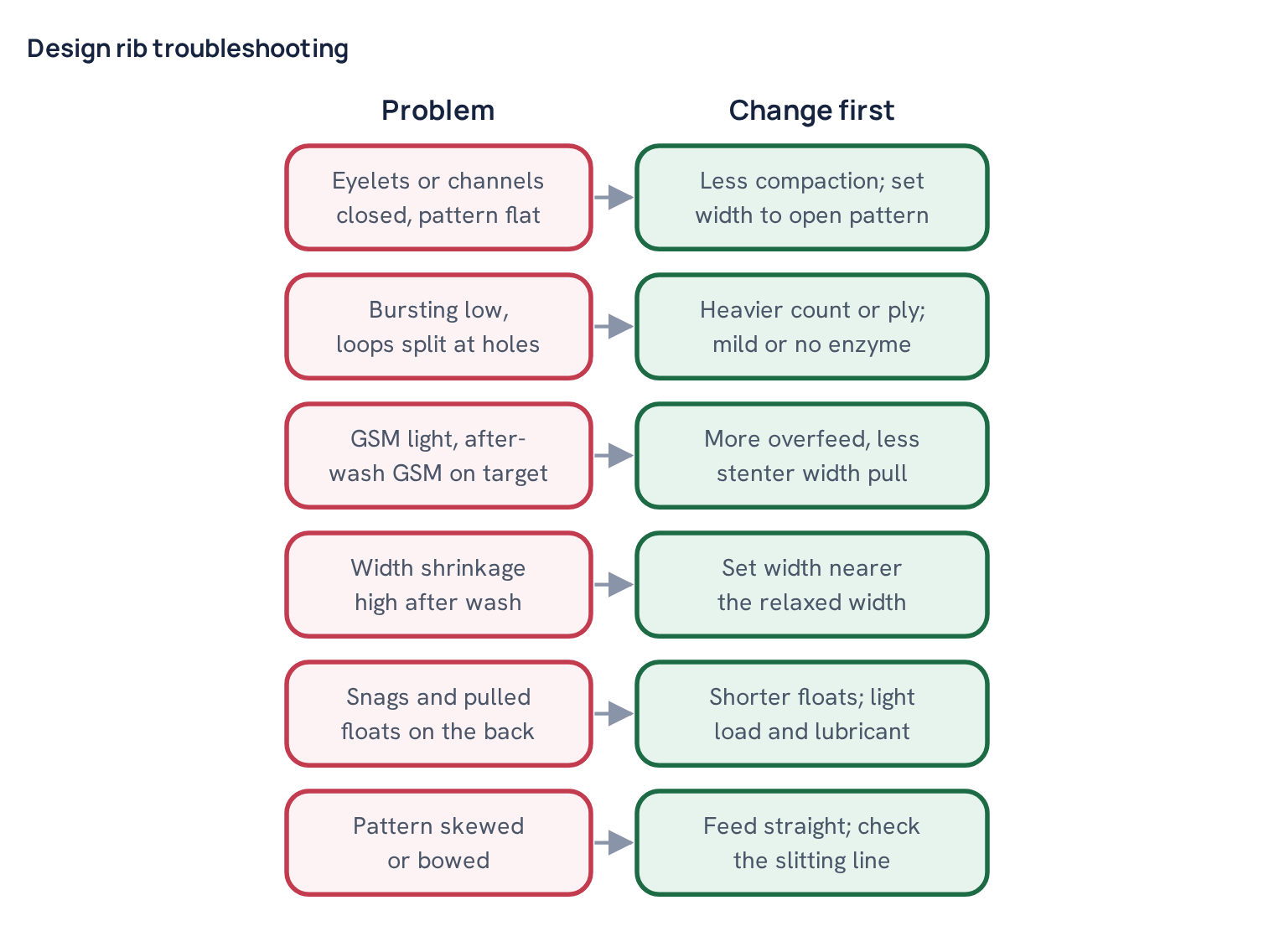
| Problem | Likely cause | What to change |
|---|---|---|
| Eyelets or channels closed, pattern flat | Heavy compaction; heat set too narrow; elastane pulling in | Less compactor overfeed; wider heat-set width; slightly longer stitch length at transfer needles |
| Eyelets stretched into ovals | Length tension in dyeing or finishing; set while stretched | Lower load and reel speed; more overfeed in heat set and stenter |
| Bursting low or loops split at eyelets | Fine count; strong bleach or enzyme; rope tension | Coarser count or ply yarn; milder pretreatment; no or mild enzyme; lighter load |
| Finished GSM low, after-wash GSM on target | Fabric held too wide or long | More overfeed, less width pull, balanced against pattern opening |
| Finished and after-wash GSM both low | Stitch length too long or yarn too fine for the design | Shorten stitch length slightly or use a heavier yarn |
| Width shrinkage high | Stenter width far above relaxed width | Set width nearer the relaxed width; plan the marker to the true width |
| Uneven channels in drop-needle rib | Uneven yarn or elastane tension; set-out error | Check set-out; equalise feeder tension and elastane draft |
| Snags and pulled floats | Long floats; friction in jet | Break long floats in the chart; lubricant; lower nozzle pressure |
| Pattern skewed or bowed | Fabric fed crooked at heat set or stenter | Straight feeding; check slitting line and weft straightener |
| Bars or uneven eyelet size across courses | Mixed yarn lots; uneven feeder tension | One yarn lot per order; equalise tension; see barre in knit fabric |
Design rib rewards the engineer who treats the pattern as part of the specification. Start from a recorded construction, protect the fabric in the dye house, finish with as little tension as the targets allow, and judge GSM, width, bursting and pattern together on one finished sample.
Questions
How is a pointelle eyelet made on a rib machine?
A selected needle transfers its loop to a neighbouring needle on the opposite bed. At the next feeder the emptied needle forms a new loop with no old loop below it, which leaves an open eyelet. A chart of transfer points forms the pattern.
What is drop-needle rib?
A rib knitted with some needles taken out or put out of action in a set order. Where a needle is out no wale forms, so a vertical channel or flat stripe runs down the fabric.
Why is design rib delicate in dyeing?
Eyelets, channels and floats are weak points. Rope tension in a jet stretches and can split them, and strong bleaching or enzyme lowers bursting strength. In our lab reports bursting ranged from 75 to 500 kPa, with a median of 194 kPa.
Does design rib finish at the required GSM?
It tends to finish light. In our records the median finished GSM is 4.6% below required, 46% of entries finish more than 5% light, and GSM rises a median 13.8% after the dye-house wash test.
How do you keep a pointelle or drop-needle pattern open in finishing?
Heat set elastane qualities at the width that gives the right opening, run the stenter with overfeed and little width pull, and use only the compaction needed for shrinkage. Judge the pattern against the approved sample at finished width.

Textile engineer with 14+ years in dyeing and fabric development. He writes every guide on Dyeing Solution from real production work. Full profile